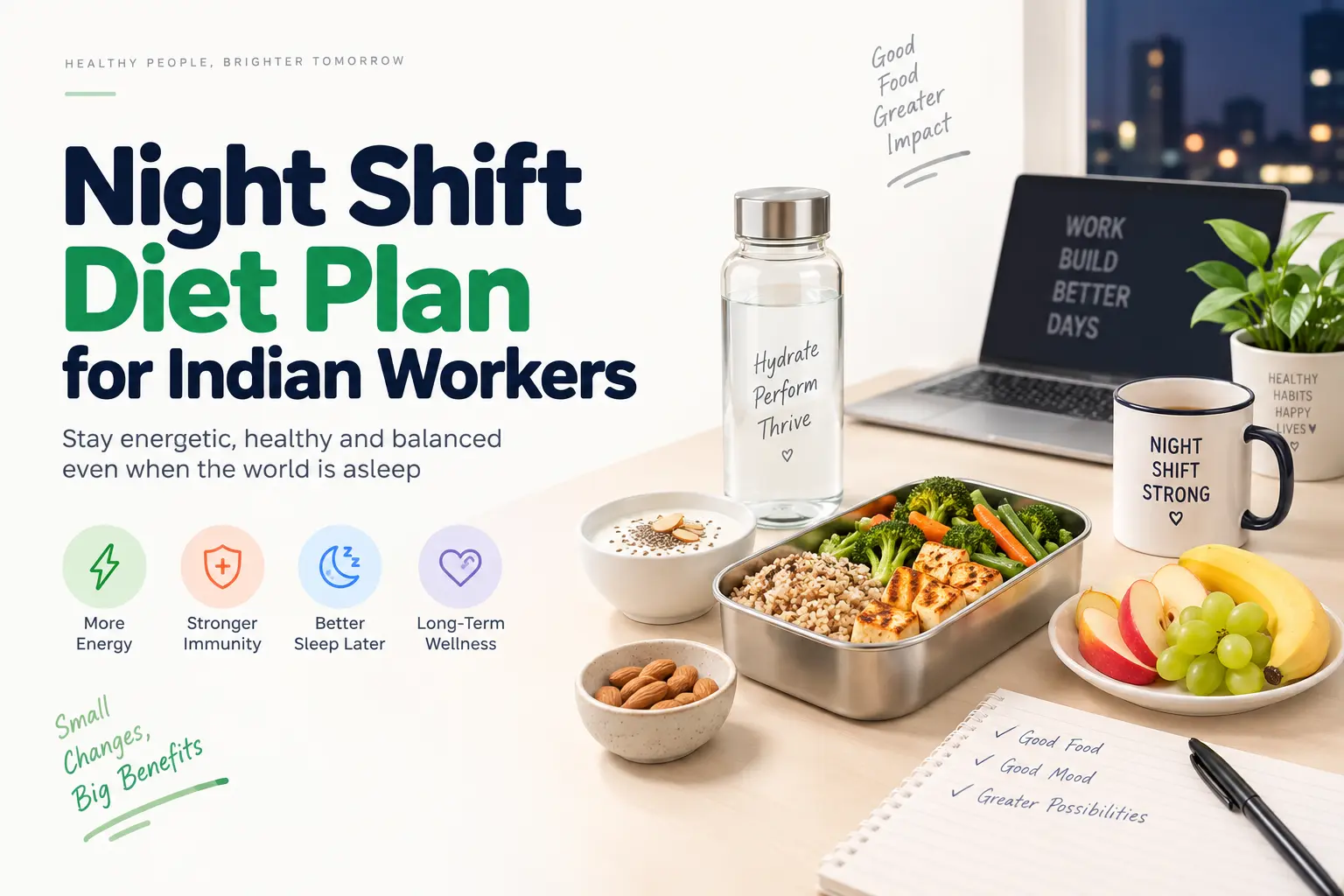
Night Shift Diet Plan for Indian Workers
Reading time: 13 minutes
By 2 AM the pantry has three things left: biscuits, a half-open packet of namkeen from Tuesday, and tea. You're not really hungry — you're tired, and at that hour tired feels almost exactly like hungry.
So you have the tea. Two sugars, because one doesn't do anything anymore. Then a colleague orders biryani and asks if you want to split it, and now you're eating a full meal at 1:40 AM you hadn't planned on. You get home at 6, still wired, eat a proper breakfast because it's morning, and sleep badly until two in the afternoon.
Nothing there is a disaster on its own. Repeated five nights a week for two years, it adds up — usually noticed as weight that arrived without any obvious cause.
The problem isn't that you're eating "at night." It's the pattern: long gaps with nothing, then a large meal when you're too tired to think. Food chosen by whatever the canteen still has. Four sweet teas standing in for sleep. Very little of this is willpower. Most of it is planning, and planning is solvable.
This is written around a roughly 8 PM to 5 AM shift — BPO floors, IT support, hospital wards, security, dispatch. Adjust the times to your own; the structure holds either way.
Why Eating Well on Night Shifts Is Genuinely Harder
Your body doesn't get a memo about the roster change. Hunger arrives when there's nothing good to eat and disappears when you're supposed to be eating.
Then there's availability. At 8 PM the canteen has a full counter. At 2 AM it has fried things and a tea urn. Fresh food is a daytime privilege.
Fatigue does the rest. On five hours of daytime sleep you don't make careful decisions — you take whatever needs zero effort, which is almost always fried or sugary. Boredom eats too; a quiet hour on a support queue is reason enough to walk to the vending machine.
And night-shift food is social in a way daytime eating isn't. When three people order at 1 AM, not ordering feels antisocial. That one dynamic probably accounts for more unplanned calories than everything else here.
Stop Treating Your Shift Like a Second Dinner
Most night-shift plans get one thing wrong: they keep the normal day's meals and add the shift's meals on top.
Look at what that becomes — dinner at 7 before leaving, a proper meal around midnight, something at 4 AM, then breakfast at 6 because you're home. Four substantial meals in eleven hours, then sleep.
You don't need a second dinner. You need your day's food spread across the hours you're awake, which happen to be different hours than most people's.
The shape that works:
One proper meal before the shift → something lighter mid-shift → a small thing late, only if you're actually hungry → sleep.
That's it. Whether the light meal lands at midnight or 2 AM depends on your shift, your commute and when you ate before leaving. The sequence matters more than the clock.
A Practical Night Shift Meal Schedule
For a shift running roughly 8 PM to 5 AM, with sleep around 6:30 AM:
| Time | What's happening | What to eat | Why |
|---|---|---|---|
| 6:00–7:00 PM | Before leaving home | Full meal: rice or roti + dal or a protein + vegetables + curd | The one meal you fully control. Plan this and the rest gets easier. |
| 10:00–11:00 PM | Settled into the shift | Usually nothing. Fruit or curd if genuinely hungry | You ate three hours ago. Most people aren't hungry yet. |
| 1:00–2:00 AM | The real hunger window | Lighter meal: 2 chapati + egg, curd rice, idli + sambar | This is where planning pays off. Left to chance it becomes samosas. |
| 4:00 AM | Low-energy stretch | Only if genuinely hungry — roasted chana, a banana, nuts | Often thirst or tiredness rather than hunger. Try water first. |
| 5:30–6:00 AM | Home | Small: curd + fruit, or one or two idlis. Or nothing | You're about to sleep, not start a day. |
| 6:30 AM | Sleep | — | — |
One worked example, not a prescription. On a 10 PM–7 AM shift everything slides two hours. If you sleep at 9 AM rather than 6:30, the post-shift meal can be slightly larger.
What to Eat Before a Night Shift
This meal matters more than the others for a boring reason: it's the only one you cook, in your own kitchen, without being tired.
Get it right and the 2 AM decision becomes small. Skip it — or make it Maggi at 7:15 because you woke late — and you'll be properly hungry by 1 AM, exactly when your options are worst.
The structure is unglamorous:
A carbohydrate + a protein + vegetables + curd if you like it.
Combinations using normal household food:
- Rice + dal + a sabzi + curd
- Chapati + chicken curry + salad
- Rice + fish curry + thoran or any vegetable
- Chapati + paneer bhurji + vegetables
- Dosa + sambar + two eggs
- Idli + sambar + boiled eggs
- Vegetable pulao + curd + a boiled egg or paneer
Protein and fibre do the work. Rice alone digests quickly and leaves you hungry by midnight; the same rice with dal, a vegetable and curd holds considerably longer — which is the whole point of eating before a shift rather than during it.
If you're sitting at a desk for nine hours, a very large meal before leaving isn't necessary and often makes the first two hours uncomfortable. Eat until satisfied, not full.
What to Eat During a Night Shift
Three situations. Worth knowing which one you're in before deciding.
If you need a proper meal — you ate early, or not at all, and you're genuinely hungry:
Chapati with chicken or paneer. Curd rice with a boiled egg. Rice, dal and a vegetable. Egg rice. Idli or dosa with sambar plus an egg. These carry you to the end of the shift without sitting heavily.
If you just need a snack — mildly hungry, a few hours left:
Fruit with a small handful of nuts. Two boiled eggs. Roasted chana. Unsweetened curd. Sprouts. A banana with peanut butter. Makhana. Any of these takes ten seconds and won't make you sluggish.
If the cafeteria is all you have, the trick isn't finding "healthy food" — most night canteens have none. It's assembling the least-bad combination from what exists:
| Better everyday choice | Usually better than |
|---|---|
| Idli + sambar | Two samosas + sweet tea |
| Egg + roti or bread | Deep-fried snacks |
| Rice + dal + vegetable | Large fried rice + soft drink |
| Curd rice | Biscuits with three teas |
| Boiled eggs + fruit | Anything from the vending machine |
None of these are forbidden. A samosa at 2 AM is not a moral failure — a samosa five nights a week, plus the tea it arrives with, is a pattern worth noticing.
The 2 AM Cafeteria Test
When the counter is limited and you can't decide, ask one question:
Can I put together a protein, a reasonable portion of carbohydrate, and something with fibre?
Two out of three is usually achievable and usually enough. Egg and two rotis gets protein and carbohydrate; add a banana from your bag for the third. Idli and sambar covers carbohydrate and some protein. Curd rice plus an egg works. Three samosas covers none of them, which is why you're hungry again at 4.
The Night Shift Food Decision Rule
Most bad night-shift eating comes from never asking whether you're hungry at all. A rule you can remember at 3 AM:
- Not hungry → don't eat just because others are, or because it's "meal time." Have water.
- A little hungry → a small snack. Fruit, chana, curd, a few nuts.
- Actually hungry → a proper balanced meal. Don't try to patch real hunger with almonds; you'll eat three times and still want food.
- Very hungry because you skipped dinner → definitely a real meal, and eat it earlier in the shift rather than at 4 AM.
The failure mode is treating the fourth case like the second. Nuts and biscuits stretched across four hours always end with something large and fried.
What Should You Eat at 1 AM or 2 AM?
There's no special 2 AM food. Nothing becomes more fattening because of the hour. What changes at 2 AM is your judgement, your options and your hunger level.
The right answer depends on when you last ate, how many hours are left, and whether you'll eat at home. Someone who ate at 6:30 PM and finishes at 5 AM needs a real meal now; someone who ate at 8:30 PM and finishes at 2:30 AM probably needs nothing.
Options that work:
- Two boiled eggs and a fruit
- Curd with a banana
- Roasted chana — the most underrated desk food in India
- Sprouts, if you've brought them
- A small portion of rice and dal
- Chapati with an egg
- Idli with sambar
- Banana with a few almonds or peanuts
What causes problems isn't any single food, it's scale — a full biryani plate at 1:40 AM, four samosas, biscuits accumulating across five teas. Nobody counts those, and they add up faster than anything else on the floor.
You can eat biryani on a night shift. A full plate at 2 AM, five nights a week, on top of dinner, is a different thing.
Chai, Coffee and the 3 AM Sugar Habit
Caffeine is how many people get through a night shift, and there's nothing wrong with using it. What's worth managing is timing, and what comes with it.
It hangs around — roughly five to six hours for the amount in your system to halve, though this varies a lot and some people are far more sensitive. A coffee at 4 AM is still partly with you at 10 AM when you're trying to sleep. If you sleep badly after shifts, pulling the last cup earlier is worth trying.
The bigger issue is usually sugar. Tea isn't making anyone gain weight. Four cups at two spoons each, five nights a week, is a meaningful amount going in almost invisibly — and it usually arrives with a biscuit. The arithmetic is in How Much Sugar Is Actually in Your Chai?.
A pattern that works: one tea or coffee early, when you need it. Water through the middle stretch — a lot of 3 AM hunger is thirst in disguise. One more later if required, with less sugar. Keep energy drinks occasional rather than systemic; they're heavily sweetened and easy to lose count of.
If you're cutting sugar in tea, drop half a spoon at a time. Two spoons to zero overnight never sticks.
What to Eat After Your Shift, Before Sleeping
You get home at 5:45. It's light outside, everyone else is starting their day, and something insists this calls for breakfast.
It usually doesn't. Two situations:
If you're genuinely hungry, keep it small and easy — curd with fruit, oats with milk, eggs with toast, a small portion of rice and dal, idlis with sambar, banana with nuts. Enough that you don't wake at 10 AM hungry, not so much that you lie down uncomfortably full.
If you're not hungry, don't eat. A full breakfast at 6 AM isn't required by anything except the label on the meal. Some people find a large or oily meal before sleep uncomfortable — if that's you, keep this one small.
Worth avoiding: the compensation meal, the big plate at 6 AM because you barely ate all night. Fix the pre-shift meal and this takes care of itself.
Can You Eat Rice During a Night Shift?
Yes. Rice at night does not have a special ability to become fat that it lacks at lunchtime.
The idea is stubborn, so plainly: weight change follows overall energy intake across days and weeks, not where the sun is when you eat a grain. Half of India eats rice at dinner and always has.
What matters is what's on the plate with it, and how much:
Balanced: A moderate portion of rice, dal, a vegetable, an egg or fish, some curd.
Less balanced: A very large portion of rice, two fried sides, a soft drink, something sweet after.
The second isn't a problem because of the rice. It's a lot of food with little protein or fibre, so you'll be hungry again before the shift ends.
If you're less active on nights than you were on days — most desk-based shift workers are — your total intake may need to be slightly lower. That's a portion conversation, not a rice one. For a number to start from rather than a guess, the TDEE calculator gives you a daily estimate.
How to Avoid Weight Gain on Night Shifts
Most of what works is unremarkable:
- Don't arrive at work very hungry. Almost every bad decision traces back to this.
- Plan one reliable meal before the shift. One. Not meal prep for the week.
- Keep emergency food at your desk. People eat vending-machine snacks because vending-machine snacks are there.
- Don't drink calories without noticing. Sweet tea, soft drinks and energy drinks add up quietly.
- Decide about the group order before you're hungry. Once someone's already ordering, you're not really choosing.
- Lead with protein and fibre — no metabolic magic, they're just more filling per plate.
- Keep the pre-sleep meal small if large meals before bed leave you uncomfortable.
- Keep some movement in the week. A walk before your shift is realistic; a 6 AM gym session usually isn't, and plans that depend on it fail.
- Watch the days off. Careful across five nights, then free for two, flattens the week's average.
- If weight is the goal, know roughly what you're eating. A week of honest self-monitoring beats a month of guessing when working unusual shifts.
A 7-Day Indian Night Shift Meal Plan
Ordinary household food, no special trip to a health store. Scale portions to your appetite.
| Day | Before shift (6–7 PM) | Mid-shift (1–2 AM) | Late, if hungry | After shift |
|---|---|---|---|---|
| Mon | Rice + dal + bhindi + curd | Curd + banana | Roasted chana | 2 idli + sambar |
| Tue | 3 chapati + chicken curry + salad | 2 boiled eggs + apple | Handful of peanuts | Curd + fruit |
| Wed | Dosa + sambar + 2 eggs | Curd rice + boiled egg | Makhana | Oats with milk |
| Thu | Rice + fish curry + vegetable | 2 chapati + egg bhurji | Guava | Nothing, or a banana |
| Fri | Vegetable pulao + curd + paneer | Sprouts + fruit | Roasted chana | 1–2 eggs + toast |
| Sat | Chapati + rajma + salad | Idli + sambar | Almonds | Curd + fruit |
| Sun | Rice + dal + egg curry + curd | Fruit + nuts | — | Small rice + dal |
The mid-shift column assumes you ate properly before leaving; if you didn't, move something more substantial into it. The "late" column is optional and most nights you won't need it. If you finish at 5 AM and sleep at 6:30, several days in the last column could reasonably be nothing.
This is an example plan, not personalised nutrition advice.
Snacks Worth Keeping at Your Desk
Twelve things that survive a drawer, cost little and are available anywhere in India:
- Roasted chana — ~10g protein in a 50g handful, keeps for weeks
- Peanuts — cheap and filling, easy to overeat from the packet
- Almonds — pre-portion them; the bag disappears otherwise
- Banana — the most practical 3 AM food there is
- Guava, apple or orange — fibre, water, no preparation
- Boiled eggs — two is about 12g protein, ten minutes at home
- Makhana — light and bulky, good to eat slowly through a quiet stretch
- Curd cup — if there's a fridge on the floor, this changes everything
- Sprouts — carry with salt, lemon and chopped onion
- Homemade sandwich — egg or paneer with vegetables
- Idli from home — travels well, genuinely good cold
- Water bottle — not a snack, but prevents more unnecessary eating than anything here
The Emergency Desk Kit
Keep four things: roasted chana, nuts, a piece of fruit, a full water bottle. That covers almost every hunger situation a shift produces, costs very little, and means never negotiating with a vending machine at 3 AM.
When It's Swiggy, Zomato or the Cafeteria
Some nights nothing is prepared and ordering is the only option. Fine — it just repays thirty seconds of thought.
South Indian: The easiest category to order well. Idli or dosa with sambar, or a meals plate with vegetables and curd. Steamed over fried where there's a choice.
North Indian: Roti with dal and a paneer or chicken dish, plus a vegetable. Ask for less oil if they'll do it.
Rice dishes: A moderate portion with a protein and something green beats a large portion of fried rice alone.
Fast food: The base item is rarely the issue — the default additions are. Fries, a large sweet drink, a dessert bundled into the combo. Order what you want without the automatic extras.
Biryani: Doesn't need avoiding — telling night-shift workers not to eat biryani is advice nobody follows. Reasonable portion rather than family size, raita with it, salad if available, not nightly. A plate once a week isn't driving anyone's weight.
A Simple Grocery List
Nothing here is a specialty item.
Protein: Eggs, curd, paneer, chicken, fish, toor or moong dal, chana, sprouts
Carbohydrates: Rice, atta, oats, idli/dosa batter, bread
Fruit: Banana, apple, guava, orange — whatever's in season and cheap
Desk snacks: Roasted chana, peanuts, almonds, makhana
Vegetables: Whatever's routine in your kitchen — bhindi, cabbage, carrot, beans, spinach, tomato, onion
The point is that it's ordinary. Night-shift eating fails from poor planning far more often than from lack of expensive ingredients.
Common Mistakes, and What to Do Instead
1. Eating almost nothing until 1 AM. You'll eat more, and worse, than if you'd eaten at 7. Fix: treat the pre-shift meal as non-negotiable.
2. Living on tea and biscuits. Feels like eating. Isn't. Fix: keep chana or nuts within reach.
3. A very large meal at 2 AM. Leaves you sluggish for the rest of the shift. Fix: move the volume earlier.
4. Running on energy drinks. Heavily sweetened, easy to lose count of. Fix: occasional, not systemic.
5. Eating because the team is ordering. Fix: decide before you're hungry, or split a portion.
6. A full breakfast at 6 AM out of habit. Fix: eat if hungry, skip if not.
7. No backup food at work. Fix: the desk kit above. Ten minutes of shopping, once.
8. Assuming eating well is expensive. Eggs, chana, curd, dal and seasonal fruit are all cheap. Fix: build around those, not protein bars.
9. Starting an extreme diet. Restriction plus sleep deprivation rarely lasts past week two. Fix: change two or three things and keep them.
10. Using a daytime plan unchanged. A 7 AM breakfast, 1 PM lunch, 8 PM dinner schedule doesn't map onto your life. Fix: keep the structure, move the clock.
If your roster rotates rather than staying fixed, expect this to be harder — start with the pre-shift meal and the desk snacks, since those travel across any pattern.
How This Looks for a BPO Employee
Shift 8 PM to 5 AM, 45-minute commute each way, asleep by 6:30 AM, awake around 2 PM.
2:15 PM — Wake. This is effectively breakfast: eggs and toast, poha, dosa, whatever's at home.
5:00 PM — Small snack if there's a gap. Fruit, tea, a few nuts.
6:30 PM — The main meal, at home. Rice or chapati, dal or a protein, a vegetable, curd. This decides how the night goes.
7:15 PM — Commute. Water bottle filled.
9:00 PM — Tea if you want it. This is the sensible one — early enough not to affect the morning.
1:30 AM — Planned mid-shift meal. Curd rice with an egg, two chapati with egg bhurji, or canteen idli and sambar.
3:30 AM — Water first. Chana or a banana if still hungry.
5:45 AM — Home. Curd and fruit if hungry, nothing if not.
6:30 AM — Sleep.
Two meals cooked, one snack carried, one canteen decision made in advance. That's the whole system. For the daytime half of the week, our office worker diet guide covers the desk-job side.
Frequently Asked Questions
What's the best food to eat during a night shift? Something with protein and fibre rather than only refined carbohydrate — eggs with roti, curd rice, idli and sambar, or dal and rice with a vegetable. Consistency matters more than the specific plate.
Can I eat rice at night? Yes. Rice doesn't behave differently after dark. Watch the portion and put protein and vegetables alongside it, and it works fine on any shift.
What should I eat at 2 AM? Depends how hungry you are. Genuinely hungry: chapati with egg, or curd rice. Mildly hungry: fruit, curd, chana or a few nuts. Not hungry: water.
Is tea okay during a night shift? Yes, in reasonable amounts — the sugar and accompanying biscuits usually matter more than the tea. Caffeine affects sleep for some people, so if you sleep badly after shifts, try moving the last cup earlier.
Should I eat after coming home from work? Only if you're hungry, and keep it small. A full breakfast before sleeping isn't required just because it's morning.
How do I avoid gaining weight on night shifts? Eat properly before the shift, keep sensible snacks at your desk, don't drink large amounts of sugar, and keep some activity in your week. Most night-shift weight gain comes from unplanned eating rather than the shift itself.
Are there healthy Indian snacks for night shifts? Roasted chana, boiled eggs, curd, fruit, sprouts, makhana, peanuts and almonds all work, cost little, and need no cooking.
Can I follow a normal Indian diet while working nights? Yes — that's the point of this plan. The same rice, dal, roti, curd and vegetables work fine. What changes is when you eat them, not what they are.
Bodies handle shift work differently, and a schedule that suits one person may not suit another. If you have diabetes, a gastrointestinal or kidney condition, are pregnant, or take medication that needs timing with food, talk to a doctor or registered dietitian before making changes — shift work makes that timing more complicated, not less.