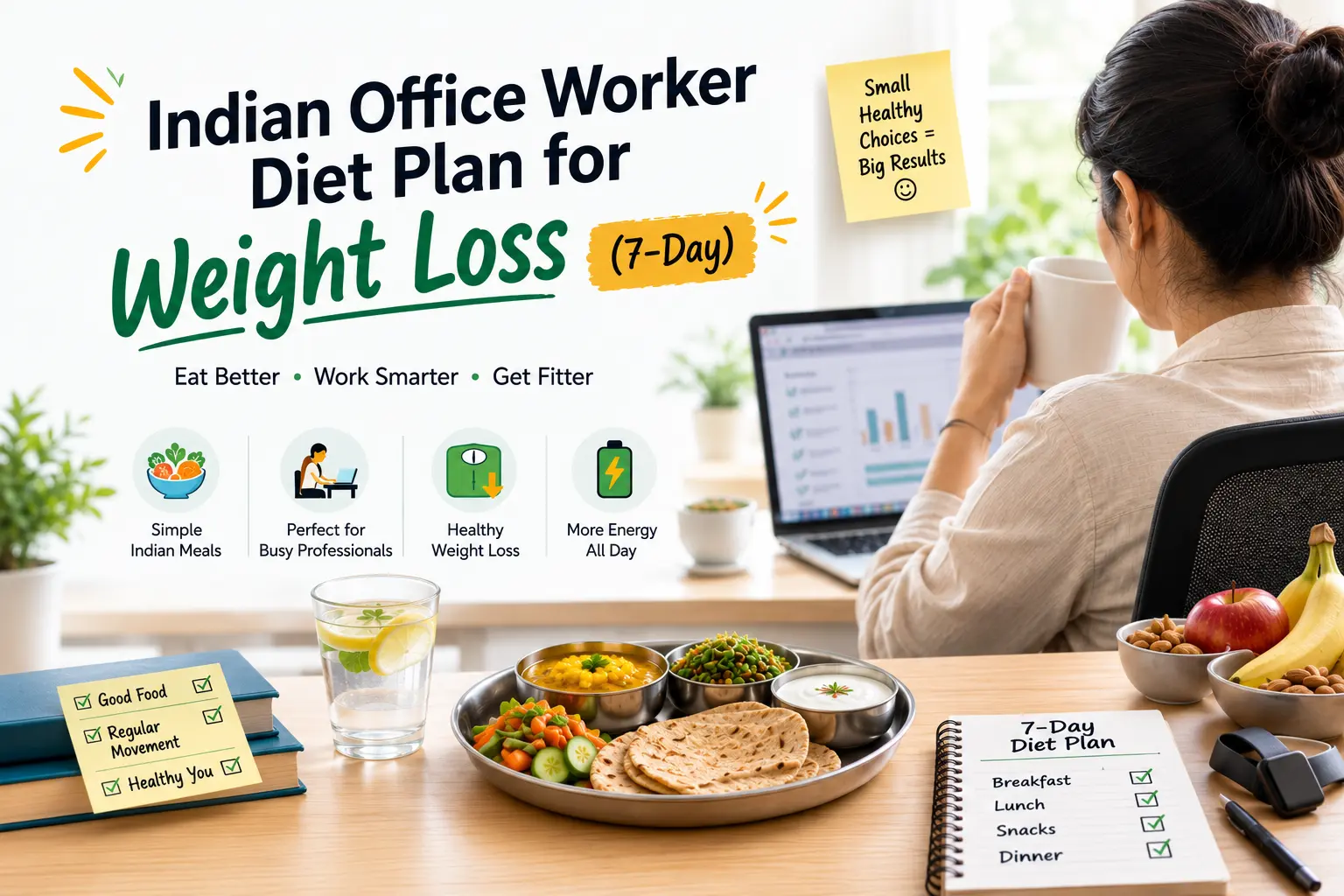
Indian Office Worker Diet Plan for Weight Loss (7-Day)
Reading time: 14 minutes
The Day That Repeats Itself
You wake up around 7:30, later than you planned. Tea first, because that's non-negotiable. Breakfast is either skipped or it's whatever can be eaten standing — two slices of bread, leftover chapati, a banana if you're lucky.
Then the commute. Then the chair.
By 11 you're hungry, so there's a biscuit with the second chai. Lunch at 1:30 is the cafeteria thali or the tiffin from home, and it's generous, because it's the one proper meal of the day. The 3 PM slump arrives on schedule. Somebody's birthday means cake at 4. Evening chai comes with a samosa or a packet of mixture. You leave at 8, reach home at 9, and dinner happens at 10 because that's when the food is ready and you're too tired to negotiate.
Sunday you weigh yourself and nothing has moved.
Here's the thing most people get wrong about this: it's rarely the Indian food that's the problem. Rice isn't sabotaging you. Roti isn't either. What usually adds up is total intake across the day — the oil you don't see, the sugar in five cups of tea, the biscuits nobody counts, the portion of rice that's twice what you think it is, and a day where your body barely moves. An Indian office worker diet plan for weight loss doesn't need to replace your food. It needs to restructure how much of it, and when.
No promises of ten kilos in a month here. Just a plan that survives a Tuesday.
Why Office Workers Struggle More Than They Should
A software developer in Bengaluru, a bank employee in Kochi, a customer support executive on a night shift, a teacher who's on her feet more than she sits — genuinely different bodies burning genuinely different amounts. But the shared pattern for most office workers is 7 to 10 hours seated, a commute where you're also seated, and an evening on the sofa.
Here's the part that trips up even people who exercise: you can do a solid 45-minute gym session and still spend the other 15 waking hours almost completely still. That workout burns real calories, but it's a small slice of the day.
The term for all that non-workout movement is NEAT — non-exercise activity thermogenesis. Ignore the jargon; it just means walking, standing, climbing stairs, walking to the shop instead of opening Swiggy. Someone hitting 10,000 steps a day is spending noticeably more energy than someone at 2,500, even if neither of them ever enters a gym.
Then there's the eating environment. Office food isn't neutral:
- Chai comes with sugar by default, and often with a biscuit you didn't decide to eat.
- Celebrations happen — birthdays, promotions, someone's last day, Diwali boxes in October.
- The cafeteria serves fixed portions built around rice or roti, with a small katori of dal and a lot of gravy.
- Group ordering means you eat what the group ordered.
- Stress and boredom make snacking feel like a break rather than a meal.
- Late work pushes dinner to 10 or 11 PM, which usually means you eat fast and eat more.
- Poor sleep makes the next day's cravings noticeably harder to manage.
- And then two weekend days of eating out can undo a careful week.
None of this is a character flaw. It's an environment. The fix is to change the environment slightly, not to develop superhuman willpower.
Movement additions that actually survive an office day: take calls standing or walking, walk 10 minutes after lunch (it also kills the post-lunch fog), use the stairs for anything under four floors, fill your own water bottle from the far cooler, and walk to the shop instead of ordering.
Don't try to add all five. Pick two you'll actually do.
What Weight Loss Actually Requires
Simply: over time, you need to take in less energy than you use. That's it. Everything else — meal timing, food choice, protein, fibre — is machinery to make that easier to sustain without feeling miserable.
Which means nothing has to be banned. Not rice, not roti, not dosa, not idli, not potatoes, not dal, not the food your mother cooks. What changes is how much, how often, and what sits next to it on the plate.
Some things you'll hear that aren't true and are worth discarding right now:
- "Rice makes you fat." Portion sizes do. So do the three helpings.
- "Carbs are bad." Most Indian diets are carb-heavy, and that's a portion issue, not a poison issue.
- "Never eat after 6 PM." For someone leaving office at 8, this is useless advice. Total intake matters more than the clock.
- "Detox drinks flush out fat." They don't. Your liver and kidneys handle that.
- "Lemon water melts belly fat." Nothing spot-reduces fat from a specific area.
Calorie needs vary a lot — age, sex, height, current weight, activity, medications, health conditions. A 5'4" woman with a desk job and a 6'1" man who plays football on weekends do not need the same food. Any number you see online is an example, not a prescription. If you have diabetes, PCOS, thyroid issues, kidney disease, are pregnant, or have a history of disordered eating, get a plan from a doctor or a registered dietitian instead of a blog post.
The Plate Formula
Rather than memorising a diet chart, learn one structure and apply it to whatever food is in front of you:
Protein + vegetables/fibre + a sensible carb portion + a little fat.
Protein is the one most Indian office workers under-eat, and it's the one that keeps you full between meals and helps preserve muscle while you're losing weight. Eggs, chicken, fish, curd, Greek yogurt if you can get it, paneer, tofu, soya chunks, dal, rajma, chana, sprouts, milk. Vegetarians can absolutely get enough — it just needs to be deliberate and spread across the day rather than one dal at lunch.
Vegetables and fibre do the heavy lifting on fullness for very few calories. Palak, methi, cabbage, cauliflower, beans, carrots, cucumber, tomato, bhindi, lauki, tinda, drumstick, whatever's seasonal and cheap in your local market. Seasonal is usually cheaper and better anyway. A large portion of sabzi or a salad next to your meal changes how much rice you actually want.
Carbohydrates stay. Rice, roti, chapati, dosa, idli, poha, upma, oats, ragi, jowar, bajra, potato, sweet potato. This is the part you control by portion rather than by elimination.
Fats are needed but they're calorie-dense, so the control is quantity, not type. Peanuts, almonds, seeds, and whatever cooking oil your family uses — mustard in the east and north, coconut in Kerala, groundnut in the west, refined oil in most offices. No oil burns fat. The teaspoon count matters more than the label on the bottle.
7-Day Indian Office Worker Meal Plan
Use this as a template, not a rulebook. Swap days, repeat what you like, adjust to your region. Vegetarian alternatives are given inline. Portions are covered in the next section.
Day 1
- Breakfast: 3 idli + sambar + 2 boiled eggs (veg: idli + sambar + a bowl of curd)
- Mid-morning: Buttermilk or an apple
- Lunch: Rice + dal + bhindi sabzi + curd + cucumber salad
- Evening: Chai + a handful of roasted chana
- Dinner: 2 chapati + chicken curry + salad (veg: 2 chapati + paneer bhurji + salad)
Day 2
- Breakfast: Vegetable omelette (2 eggs) + 1 slice toast (veg: paneer bhurji + 1 roti)
- Mid-morning: Banana
- Lunch: Rajma + rice + salad + curd
- Evening: Chai + makhana
- Dinner: Vegetable pulao (small portion) + curd + a boiled egg or soya chunk curry
Day 3
- Breakfast: Poha with peas and peanuts + a bowl of curd
- Mid-morning: Sprouts chaat
- Lunch: 2 roti + chana masala + mixed vegetable sabzi + salad
- Evening: Coffee (less sugar) + a few almonds
- Dinner: Rice + fish curry + cabbage thoran (veg: rice + dal + thoran + paneer)
Day 4
- Breakfast: Oats with milk, a few nuts and chopped fruit
- Mid-morning: Buttermilk
- Lunch: Cafeteria thali — take the rice/roti as served, ask for extra dal or curd, extra sabzi, skip the fried side and the sweet
- Evening: Chai + roasted peanuts
- Dinner: 2 chapati + palak paneer + salad (non-veg: 2 chapati + egg curry + salad)
Day 5
- Breakfast: 2 dosa + sambar + chutney + a boiled egg (veg: add a glass of milk)
- Mid-morning: Orange or guava
- Lunch: Curd rice (moderate portion) + a vegetable side + boiled egg or paneer cubes
- Evening: Chai, no biscuit; a fruit if you're hungry
- Dinner: Grilled chicken + sautéed vegetables + 1 roti (veg: tofu/soya chunk stir-fry + 1 roti)
Day 6
- Breakfast: Upma with vegetables + 2 eggs (veg: upma + curd)
- Mid-morning: A handful of peanuts
- Lunch: Whatever the family is eating — apply the plate formula. Half vegetables, a fist of rice, a proper protein.
- Evening: Chai + homemade snack, portioned onto a plate
- Dinner: Millet roti (ragi/jowar) + dal + sabzi + salad
Day 7
- Breakfast: Paratha (one, lightly oiled) + curd + a boiled egg
- Mid-morning: Skip if not hungry
- Lunch: The meal you were looking forward to — biryani, a restaurant thali, whatever it is. Eat it properly, at a normal portion, with some raita or salad alongside.
- Evening: Tea + fruit
- Dinner: Something light — soup with vegetables and chicken/paneer, or a bowl of dal with one roti
Notice that Day 7 has biryani in it. That's deliberate. A plan you resent for six days and abandon on the seventh isn't a plan.
Portion Control Without a Weighing Scale
Most people don't need to weigh food. They need a consistent reference.
The plate method is the easiest starting point: half the plate vegetables or salad, a quarter protein, a quarter carbs. For an Indian thali, mentally translate that into a large sabzi portion, a solid katori of dal or a piece of chicken/fish/paneer, and a controlled serving of rice or roti.
Hand-size guidance works when you're eating out:
| Component | Rough portion |
|---|---|
| Cooked rice | One cupped hand, roughly one medium katori |
| Roti/chapati | 1–3 depending on your size, hunger and activity |
| Protein (chicken/fish/paneer) | One palm-sized portion |
| Vegetables | Two cupped hands, or more |
| Nuts | One small handful, not a bowl |
| Cooking oil | 3–4 teaspoons per person per day, total |
The oil line is the one people miss most. A tablespoon is about 120 calories, and a family curry can carry three or four of them.
If you want an example: a moderately active office worker might land somewhere around 1,500–1,900 calories a day while losing weight — but treat that purely as an illustration of the ballpark, not a target you should adopt. Your number depends on your body and your day. If you'd rather not count at all, controlling portions and eating protein at every meal gets most people most of the way there.
Indian Breakfast Ideas
A tiny breakfast sounds efficient until 11 AM, when it turns into biscuits, and 1:30, when it turns into an oversized lunch. Some people genuinely do fine skipping breakfast — if that's you and your lunch doesn't blow up, carry on. For most office workers, a breakfast with actual protein makes the rest of the day easier.
Fast options that hold up:
- Idli + sambar + 2 eggs — sambar brings dal protein, eggs bring the rest.
- Dosa + sambar + curd — keep it to one or two, go easy on the oil.
- Vegetable omelette + toast — five minutes, high protein.
- Poha with peanuts and peas + curd — the curd is what turns it from a carb plate into a meal.
- Upma + eggs or curd
- Oats with milk, fruit and nuts — boring, effective, and no cooking skill required.
- Paneer or tofu bhurji + roti
- Overnight oats — the night-before option for people who leave at 7:30.
If mornings are genuinely impossible, make breakfast portable: boiled eggs and a fruit in a box, or curd and poha carried to your desk. Eating at your desk at 9:30 beats not eating until 1:30.
Healthy Office Lunch Ideas
Lunch is where a good day is usually won or lost. Five combinations that all work:
- Rice + dal + vegetable sabzi + curd — the classic. Just check the rice portion.
- Roti + chicken curry + sabzi + salad
- Rice + fish curry + a vegetable thoran or poriyal
- Chapati + paneer or tofu + vegetables
- Rajma or chana + rice + salad
For tiffin-packers, the single highest-value change is packing the vegetables and protein first, and the rice or roti last, in whatever space remains. Most lunch boxes are packed in the opposite order.
If you eat at the cafeteria, you have less control but more than you think. Take the vegetables and dal generously, take the rice as served rather than asking for extra, skip or share the fried item, and skip the sweet on most days. If there's a curd or buttermilk option, take it. If the cafeteria protein is thin, keep boiled eggs, a small pack of roasted chana or a curd cup in your bag and add it yourself.
You don't need a perfect lunch. You need a lunch that isn't 70% rice.
The Office Snack Problem
Biscuits, samosa, pakora, chips, mixture, bakery puffs, sweets, chocolates, that bottle of cold drink at 4 PM. None of these are evil. Any of them can fit into a week. The issue is that office snacking is usually automatic — you eat because the packet is open, because everyone else is, because the meeting was long.
The distinction worth learning is planned versus mindless. A planned snack is one you decided on: a fruit at 11, chana at 4. A mindless snack is whatever was on the table.
Keep replacements within arm's reach, because that's the only place they work:
- Fruit — banana, apple, orange, guava, whatever's in season
- Curd or buttermilk
- Roasted chana
- Peanuts, but a fistful, not a packet
- Boiled eggs
- Sprouts
- Makhana
- A few almonds or walnuts
- Home-made chivda or roasted snacks, portioned into small boxes
And a small mechanical trick that works better than willpower: never eat from the packet. Put it on a plate or in a bowl first. It's the difference between eating six biscuits and eating two.
Chai, Coffee and the Biscuit Reflex
Nobody is asking you to give up chai. That advice gets ignored, and rightly so.
But do the arithmetic once. Five cups a day, two teaspoons of sugar each, plus milk, plus two biscuits with most of them — that's easily 400–500 calories that nobody remembers eating. The tea isn't the problem. The sugar, the biscuit reflex, and the sheer count are.
What actually works:
- Reduce sugar gradually — two spoons to one and a half, then one. Do it over weeks; taste adjusts.
- Break the automatic pairing. Tea can just be tea.
- Cap the count. Three cups instead of six is a real change with no suffering.
- Watch the café drinks. A frappé or caramel latte can carry more calories than a full meal. Regular filter coffee, black coffee, or a plain cappuccino are entirely different animals.
- Keep a water bottle on your desk. A lot of the 4 PM tea is thirst with extra steps.
Ordering In and Eating Out
"Avoid restaurant food" is not advice a working professional can use. You're going to order. So order better.
The pattern that causes damage is: a fried starter, a creamy or buttery main, naan or parotta, rice as well, and a sweet drink. That's a full day's calories in one sitting, easily.
A better shape for the same meal: a tandoori or grilled protein, a dry or tomato-based sabzi/curry rather than a malai/butter one, a controlled portion of rice or two rotis rather than both, and water, buttermilk or nimbu pani instead of a soft drink.
Some specifics:
- Biryani — order one plate, not one plus a starter. Add raita. Eat the meat, leave some of the rice if the portion is large.
- Dosa — plain, masala or set dosa with sambar is a reasonable meal. Ghee roast is a different story.
- Thali/meals — genuinely one of the better options because it's balanced by design. Just moderate the rice refills and skip the payasam.
- North Indian — tandoori chicken, kebabs, dal, jeera rice, tandoori roti. The butter/malai/korma family is where the calories hide.
- Fried rice and noodles — pick one, add an egg or chicken, skip the manchurian gravy.
- Parotta — very oily and easy to eat four of. Two with a protein-heavy curry is a workable compromise.
- Wraps and sandwiches — reasonable when they're grilled and the filling is protein-based; less so when everything is mayo.
One thoughtful decision at the order screen beats three days of guilt afterwards.
If You Work From Home
Remote work removes the commute and the cafeteria, then hands you a kitchen twelve steps away.
The common patterns: grazing all day because food is right there, eating lunch at your laptop without noticing it, skipping meals entirely during a busy sprint and then eating everything at 9 PM, and a step count that barely crosses 1,500.
What helps:
- Fix your meal times and treat them like meetings. Eating on a schedule prevents the 4 PM raid.
- Cook or prep lunch the night before so the midday decision is already made.
- Portion snacks into boxes on the weekend. Never work with an open packet next to the keyboard.
- Eat away from your desk, even if it's just the dining table for ten minutes. Distracted eating genuinely leads to eating more.
- Walk between meetings. A 10-minute loop three times a day is 30 minutes you didn't have before.
- Take calls standing or pacing.
- Keep a full water bottle at the desk.
Vegetarian Protein
Vegetarian office workers can absolutely lose weight and hold onto muscle. It just needs planning, because a typical veg Indian day is heavy on carbs and light on protein.
Reliable sources: dal (all of them), rajma, chana, lobia, soya chunks, tofu, paneer, curd, milk, sprouts, green peas, and peanuts. Soya chunks in particular are cheap, widely available, and very high in protein per rupee — they work well in curries and pulao.
The practical approach is to add protein to every meal rather than relying on one big dal at lunch. Curd with breakfast, a katori of dal or chana at lunch, sprouts or roasted chana in the evening, paneer or tofu at dinner. Combining across the day — grains with legumes, which is what dal-chawal and roti-chana already do — covers the amino acid question without any special effort.
If you're vegan, skip the dairy and lean harder on soya, tofu, legumes and nuts, and consider a B12 supplement after talking to a doctor.
Non-Vegetarian Options
Eggs are the best value protein in most Indian cities — boiled, omelette, bhurji, curry. Two or three a day suits most people; if you have a cholesterol concern, ask your doctor rather than a blog.
Chicken breast is leanest, but thigh and curry cut are fine too — cook them with less oil rather than avoiding them. Fish deserves more attention than it gets: rohu, mackerel, sardines, seer, whatever's local and affordable. Prawns are lean and cook fast. Mutton and red meat aren't off-limits, just fattier and worth treating as a couple of times a week rather than daily.
Preparation matters more than the meat. Grilled, tandoori, steamed, air-fried, curried with a modest amount of oil — all fine. Deep-fried and thick malai gravies are where the same chicken doubles or triples in calories.
What About Rice?
This comes up in every conversation, so let's be direct: rice does not stop weight loss.
A katori of cooked rice is roughly 130–150 calories. Three heaped servings is another matter, but that's a portion question. Plenty of people across Kerala, Tamil Nadu, Andhra, Bengal and the North East eat rice twice a day and are perfectly lean — because the rest of the plate has fish, dal, curd and a pile of vegetables, and because the portion is consistent.
What to do:
- Keep it to one or two katoris per meal, adjusted to your hunger and activity.
- Never eat rice alone. Pair it with dal, curd, fish, chicken, paneer or egg.
- Load vegetables onto the same plate first; you'll want less rice.
- Choose whatever rice you actually like and can afford. Brown rice and red rice have a bit more fibre, which some people find more filling — but white rice in a controlled portion works fine, and nobody needs to buy imported "fitness" rice.
What About Roti?
Same answer, different grain. A medium chapati is roughly 70–110 calories depending on size and how much ghee goes on it.
Two to three rotis at a meal suits most people. The variables that matter are size (a Punjabi-style roti and a small chapati are not the same food), the flour, and the fat added afterwards. Whole wheat atta is a solid default. Ragi, jowar and bajra rotis add fibre and variety, and are genuinely good options in winter. But no flour burns fat, and multigrain atta from a packet isn't automatically better — check whether it's actually mixed grains or wheat with a nice label.
The ghee question: half a teaspoon on a roti is fine. It's when every roti gets a generous smear that the numbers move.
Water, Sleep and Stress
Water doesn't burn fat. It does keep you from mistaking thirst for hunger, and it's easier to remember when a bottle is sitting on your desk.
Sleep is underrated by office workers specifically. Short sleep tends to increase appetite and push you towards quick, high-calorie food the next day — and it makes the gym feel far less appealing. If you're consistently getting five hours because of late deployments or a long commute, that's a weight-loss variable, not just a tiredness one.
Stress eating is real and it isn't weakness. Deadlines, appraisals, difficult managers, long shifts — food is an available comfort. Noticing the pattern is most of the fix: if you're reaching for the drawer at 6 PM on hard days, keep something in that drawer that isn't a chocolate bar. If eating feels genuinely out of your control, that's worth talking to a professional about.
Movement, Not Just Workouts
This is a diet article, but the two work together and pretending otherwise is dishonest.
You don't need two hours a day. A realistic setup for a working professional:
- Walking daily. Build up towards 7,000–10,000 steps, but if you're at 3,000 now, aim for 5,000 first. Post-lunch and post-dinner walks are the easiest to make stick.
- Strength training 2–4 times a week. Gym, home dumbbells, resistance bands, or bodyweight. This is what protects muscle while you're eating less, and it matters more than cardio for how you end up looking.
- Something you enjoy on weekends — cycling, badminton, swimming, cricket. Consistency comes from enjoyment more often than from discipline.
Start below what you think you can handle. The person who does three sessions a week for a year beats the person who does six for three weeks.
A Sample Day
An example, not a schedule. Shift workers, night-shift support staff and people with 90-minute commutes will need to shuffle this considerably.
| Time | What |
|---|---|
| 7:00 AM | Wake up, water, tea if that's your habit |
| 8:00 AM | Breakfast with protein |
| 10:30 AM | Optional snack — fruit or buttermilk |
| 1:00 PM | Lunch, then a 10-minute walk |
| 4:30 PM | Tea + a planned snack |
| 6:30 PM | Walk or workout |
| 8:00 PM | Dinner |
| 10:30 PM | Wind down, screens away |
If you get home at 9:30, dinner at 10 is fine. Eating at 10 does not automatically store fat. Eating a large, uncontrolled meal at 10 because you barely ate all day is the actual problem.
10 Common Mistakes
- Skipping breakfast, then overeating. Fine for some people, a trap for most. Watch what happens at lunch.
- Drinking calories. Sweetened tea, café drinks, fruit juice, cold drinks. They don't fill you up but they count.
- The biscuit reflex. Tea does not require a biscuit. That's habit, not hunger.
- Underestimating oil. The single most under-counted item in Indian home cooking.
- Rice by eye. Two heaped servings looks the same as one moderate one until you use a katori.
- Not enough protein. The most common gap, and the one that makes dieting feel like starving.
- Eating while working. You finish the plate and register almost nothing.
- Weekend blowout. Five careful days plus two large ones often nets out to zero.
- Trusting "healthy" packaging. Diet biscuits, granola bars, baked chips, "sugar-free" sweets. Read the label.
- Expecting speed. Meaningful change shows up over months. Weekly weight fluctuates with salt, water and hormones — don't let a Tuesday reading derail you.
The Weekend
Two days can quietly undo five. Late breakfast at 11, a big family lunch, biryani or a restaurant dinner, sweets because someone visited, drinks on Saturday night, and a step count under 2,000 because you didn't leave the house.
The answer isn't to skip your cousin's wedding lunch. It's to keep the week as the unit of measurement rather than the day.
- Eat normally on Saturday morning instead of "saving up" for the big meal — that backfires almost every time.
- Pick one indulgent meal, not four. If Saturday dinner is the plan, keep Sunday ordinary.
- Alcohol is calorie-dense and lowers your resistance to whatever's on the table. If you drink, decide the number in advance and stay hydrated.
- Move on weekends. A morning walk, a cycle ride, a game — weekends are when you actually have the time.
- Sunday evening, do a small amount of prep: boil eggs, soak dal, chop vegetables, portion snacks. Twenty minutes buys you a much easier Monday.
Making It Last
The best diet plan for working professionals is the one that survives a bad week at work.
Boring is a feature. Most lean people eat the same four or five breakfasts on rotation. Deciding is what drains you, not repetition.
A few things that make consistency easier:
- Keep protein available at home at all times — eggs, curd, paneer, dal, soya chunks. If it's there, you'll use it.
- Prep partially, not perfectly. Chopped vegetables and cooked dal on Sunday is enough.
- Plan your office snacks the same way you plan your meals.
- Track food for a couple of weeks if you're unsure where the calories are coming from. Most people discover something surprising — usually oil, tea sugar or portion size. You don't need to track forever.
- Drop all-or-nothing thinking. One heavy meal is one meal. It's not a failed week, and it certainly isn't a reason to abandon the plan until Monday.
- Judge yourself on the number of good days per month, not per day.
Building Long-Term Consistency
The hard part of all this isn't knowing what to eat — you probably knew half of this already. It's staying consistent across three months of shifting deadlines, travel, festivals and tiredness.
Focus on simple systems: tracking your daily habits, keeping your schedule manageable, and noticing when consistency starts slipping — before it's slipped for a month.
If you're trying to turn the advice in this article into an actual routine, that steady consistency is the thing that makes the difference.
FAQ
What is the best Indian diet for an office worker trying to lose weight? There isn't one single best plan, but the structure that works for most desk-based professionals is: a protein-containing breakfast, a balanced lunch of vegetables plus dal or a meat/paneer dish with a controlled rice or roti portion, one planned evening snack, and a moderate dinner. Keep your usual regional foods, control portions, add protein and vegetables to every meal, and increase daily walking. It should look like your normal food, not a special diet.
Can I eat rice and still lose weight? Yes. Rice doesn't prevent fat loss — total calorie intake determines that. A katori or two per meal, paired with dal, curd, fish, chicken or paneer and a good portion of vegetables, fits comfortably into a weight-loss diet. Millions of people across rice-eating regions of India are lean while eating it daily. Choose whichever rice you prefer and can afford; you don't need special varieties.
What should I eat for lunch at the office to lose weight? Aim for half your plate as vegetables or salad, a clear protein source (dal, rajma, chana, curd, egg, chicken, fish, paneer or tofu), and a moderate portion of rice or 2–3 rotis. If you pack a tiffin, fill the vegetables and protein first and the carbs last. At a cafeteria, take extra sabzi and dal, take the rice as served, skip the fried item and the sweet most days.
What are the best Indian snacks for weight loss? Roasted chana, makhana, sprouts, boiled eggs, buttermilk, curd, fruit, and a small handful of peanuts or almonds all work well because they add protein or fibre without many calories. The bigger win is portioning: put the snack on a plate instead of eating from the packet. Occasional samosa or biscuits are fine — they just shouldn't be the daily default.
How can I lose weight if I sit at a desk all day? Focus on two things: controlling total food intake, and adding movement outside your workout. Take calls standing, use the stairs, walk 10 minutes after lunch, and build your daily step count gradually. A desk job lowers your daily energy expenditure, so portions need to match that reality. Adding 2–3 strength sessions a week helps preserve muscle while you lose fat.
How much protein should an office worker eat? Requirements vary with body weight, activity and health status, so there's no universal figure. In practice, most people trying to lose weight benefit from including a protein source in every meal rather than hitting one exact number — eggs or curd at breakfast, dal or a meat/paneer dish at lunch and dinner, and a protein-containing snack. If you have kidney disease or another medical condition, ask your doctor before increasing protein significantly.
Is skipping breakfast good for weight loss? It's neither good nor bad on its own. Some people naturally eat less overall when they skip breakfast, and for them it works. Others get very hungry by midday and overeat at lunch and through the evening, which cancels out the saving. Try both honestly for two weeks and see which leaves you eating less across the whole day.
Can I drink tea while trying to lose weight? Yes. Tea and coffee themselves contribute few calories. What adds up is the sugar, the full-cream milk, the café syrups, and the biscuits that come with them. Reduce sugar gradually, break the automatic tea-plus-biscuit habit, and keep an eye on the total number of cups. Three cups of moderately sweetened chai is unlikely to be what's holding back your progress.
Can vegetarian Indians get enough protein? Yes, with a bit of planning. Dal, rajma, chana, soya chunks, tofu, paneer, curd, milk, sprouts and peas all contribute meaningfully. The key is spreading protein across all meals rather than depending on a single dal at lunch. Grain-and-legume combinations that Indian cooking already uses — dal-chawal, roti-chana — cover the amino acid picture without any special effort.
How many meals should I eat per day for weight loss? Whatever number fits your schedule and keeps you comfortable. Three meals plus one or two planned snacks suits most office workers, but three meals with nothing between works equally well for some. Meal frequency has little independent effect on fat loss; total intake and consistency matter far more. Pick the pattern you can hold on a busy Wednesday.
Can I eat outside while trying to lose weight? Yes, and you'll last longer if you do. Choose grilled or tandoori proteins over fried, prefer tomato- or dal-based gravies over malai and butter ones, pick either rice or bread rather than both, and drink water or buttermilk instead of soft drinks. One planned restaurant meal a week fits easily into an otherwise controlled diet.
How long does it take to see weight-loss results? Most people notice changes in energy and how clothes fit within four to six weeks of consistent eating and movement. Scale weight fluctuates daily with water, salt and hormones, so judge progress over three to four weeks rather than day to day. Anyone promising a dramatic drop in a fortnight is selling something.
Final Thoughts
You don't need imported foods, protein powders you can't pronounce, an expensive keto plan, or a 16-hour fast to lose weight while working an office job in India. You don't need to give up rice, or chai, or the biryani you look forward to all week.
What actually works is unglamorous: a protein source at every meal, vegetables in real quantity, portions you can eyeball consistently, snacks you decided on in advance, a bit more walking than yesterday, and a willingness to keep going after the weeks that go badly. Adjust it to your region, your budget, your commute and your shift. The plan that fits your life is the one that's still running in six months.
Start with two changes this week — not ten. Maybe a proper breakfast and a walk after lunch. Add the next thing when those feel automatic.
Consistency and simple daily systems are what turn temporary effort into permanent habits.
This article is general information, not medical advice. If you have diabetes, thyroid disorders, PCOS, kidney disease, are pregnant or breastfeeding, or have a history of disordered eating, please consult a doctor or registered dietitian before changing your diet.