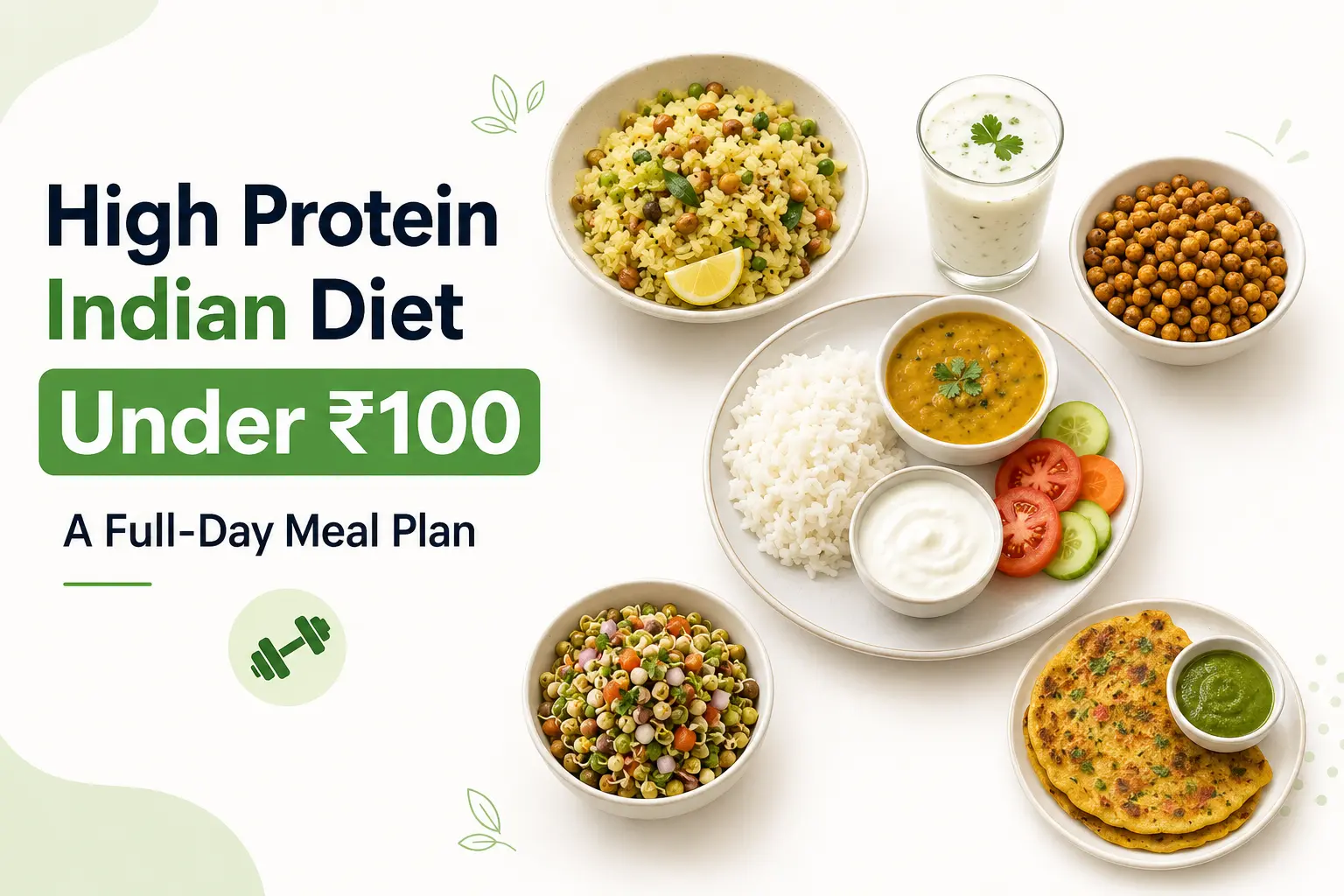
High Protein Indian Diet Under ₹100: A Full-Day Meal Plan
Reading time: 13 minutes
Most people who decide to eat more protein in India start by opening a supplement website, looking at a ₹3,000 tub of whey, and quietly abandoning the idea.
That's a shame, because the cheapest protein in this country isn't in a tub. It's sitting in a plastic packet in your kirana shop, costs about ₹120 a kilo, and almost nobody in the gym talks about it.
This article does one thing: it builds an actual full day of Indian meals for around ₹100 and shows you what protein you get for that money. Not a list of "top 10 protein foods." A plan, with prices, with arithmetic you can check.
A note on the prices before we start. Every rupee figure here is approximate and based on mid-range Indian retail prices in 2026. What you pay in Kochi differs from Delhi, a local mandi differs from a supermarket, and a 5kg pack differs from a 200g pouch. Treat these as a budgeting framework, not a quotation. Protein values are approximate too — from standard nutrition databases like ICMR-NIN and USDA FoodData Central — and shift with variety, brand and how you cook.
Can You Really Get Enough Protein for ₹100 a Day?
Short answer: yes, for many people. Roughly ₹90 of ordinary Indian groceries — soya chunks, dal, eggs, rice, roti, milk and roasted chana — can deliver somewhere around 95 to 105g of protein across a full day. Whether that's enough depends on your body weight and goal, which is a different question from whether it's affordable.
Here's the honest framing. "High protein" isn't a fixed number. Someone at 55kg doing desk work and someone at 85kg lifting five days a week need very different amounts. ICMR's baseline recommendation for healthy Indian adults sits around 0.83g per kg of body weight per day, and notably it goes up to about 1g per kg for people eating a mostly cereal-based diet — which describes most of India. People training seriously often target 1.2 to 2.0g per kg.
Run that for a few body weights:
| Body weight | Baseline (~1g/kg) | Training target (~1.6g/kg) |
|---|---|---|
| 55 kg | ~55g | ~88g |
| 65 kg | ~65g | ~104g |
| 75 kg | ~75g | ~120g |
| 85 kg | ~85g | ~136g |
So ₹100 comfortably covers a 65kg person's baseline and gets close to a training target in the 60–65kg range. For an 85kg person chasing 136g, it's a strong foundation but not the whole answer.
Read this article as: ₹100 is not a protein target, it's a budget. The job is squeezing the most protein out of it.
Protein Per Rupee: The Only Number That Matters Here
When money isn't a constraint, you ask which food has the most protein? The answer is paneer, chicken, eggs — the usual list.
When money is the constraint, that's the wrong question. The right one is:
How many grams of protein does one rupee buy?
The formula is simple enough to do on your phone in the shop:
Cost per 10g protein = (price of the food ÷ protein it contains) × 10
Worked example. A kilo of soya chunks costs roughly ₹120. Dry soya chunks are about 52g protein per 100g, so a kilo holds around 520g of protein.
₹120 ÷ 520g = ₹0.23 per gram → about ₹2.30 per 10g of protein.
Now paneer. Roughly ₹400/kg, about 18g protein per 100g, so 180g of protein per kilo.
₹400 ÷ 180g = ₹2.22 per gram → about ₹22 per 10g of protein.
Same nutrient. Nearly ten times the price. That single comparison is the entire strategy of this article.
The Best Budget Protein Sources in India
All figures approximate. Prices are mid-range retail and will move around you.
| Food | Serving | Approx. protein | Approx. cost | ₹ per 10g protein |
|---|---|---|---|---|
| Soya chunks (dry) | 100g | ~52g | ~₹12 | ₹2.3 |
| Toor dal (dry) | 100g | ~22g | ~₹8 | ₹3.6 |
| Peanuts | 100g | ~25g | ~₹15 | ₹6.0 |
| Roasted chana | 100g | ~20g | ~₹13 | ₹6.5 |
| Chicken (curry cut) | 100g raw | ~22g | ~₹24 | ₹10.9 |
| Eggs | 2 eggs | ~12g | ~₹15 | ₹12.5 |
| Toned milk | 200ml | ~6.4g | ~₹12 | ₹18.1 |
| Curd | 100g | ~3.3g | ~₹7 | ₹21.8 |
| Paneer | 100g | ~18g | ~₹40 | ₹22.2 |
A few things worth saying about each.
Soya chunks are the outlier and the reason a ₹100 protein day works at all — about 52g of protein per 100g dry, higher per gram than chicken, at roughly a tenth of paneer's cost per gram. They triple in weight when soaked, so 60g dry is a substantial portion. High in fibre, so build up gradually.
Dal is the quiet workhorse — not as protein-dense as soya, but already in your kitchen and second-best value in the country at ~₹3.6 per 10g. The catch is dilution: a thick dal made from 50–60g dry per person delivers real protein, a watery one delivers colour.
Roasted chana is the best snack on this list. No cooking, no fridge, keeps for weeks, and a 50g handful gives about 10g of protein for around ₹6.50. If you replace one packet of namkeen a day with roasted chana, you've made a meaningful change with no effort.
Peanuts are excellent value per gram of protein but very calorie-dense — roughly 570 kcal per 100g. Good in a 15–25g scattering on poha or as part of a snack; not something to eat by the bowl if you're watching calories.
Eggs aren't the cheapest per rupee but they're the most convenient real food here — boiled, bhurji, curry, on top of anything, at ₹7–8 each. A sensible everyday addition rather than the backbone of a budget plan.
Milk and curd look poor on the protein-per-rupee table and strictly speaking they are — but they bring calcium and curd helps a heavy dal-and-soya day sit better. Keep them; just don't lean on them for bulk protein.
Chicken and paneer are the two that will eat your budget. Chicken at roughly ₹11 per 10g of protein is respectable — but 250g of it costs ₹60, which is more than half of your ₹100 gone in one ingredient. We'll look at exactly what that does to a day's plan later.
The ₹100 One-Day Meal Plan
This is a mixed plan using eggs and dairy. A fully vegetarian version follows.
All weights are dry/raw unless stated, because that's how you buy and measure things. 100g of dry rice becomes roughly 250–300g cooked; 50g of dry soya chunks becomes about 150g soaked. Mixing raw and cooked weights is the single most common tracking error, and we'll come back to it.
Breakfast — 3 eggs + 2 rotis
Boiled, bhurji or omelette, whatever you have time for. Two rotis from about 60g of atta alongside.
- Approximate cost: ₹25
- Approximate protein: ~25g
Why it works: eggs give you 18g before you've thought about it, and the atta quietly adds another 6–7g that most people never count. Wheat isn't a protein food, but three rotis a day still contributes about 10g.
Lunch — rice + thick dal + curd
100g dry rice, 50g dry toor dal cooked thick, a small bowl of curd, plus whatever sabzi is being made.
- Approximate cost: ₹28 (including vegetables)
- Approximate protein: ~21g
Why it works: this is a completely ordinary Indian lunch. The only change from what most people already eat is making the dal properly thick instead of watering it down to stretch it.
Evening snack — roasted chana
A 50g handful, straight from the packet.
- Approximate cost: ₹6.50
- Approximate protein: ~10g
Why it works: this is the slot where most Indian diets leak. Biscuits, namkeen or a samosa here costs similar money and gives almost no protein. Same spend, 10g better.
Dinner — soya chunks curry + rice
50g dry soya chunks, soaked and squeezed, cooked into an onion-tomato masala. 80g dry rice alongside.
- Approximate cost: ₹22 (including onion, tomato, oil, spices)
- Approximate protein: ~32g
Why it works: this is the single highest-protein meal of the day and costs about ₹22. The soya alone contributes 26g. If you've never cooked soya chunks, squeeze them hard after soaking — that's the difference between a good curry and a spongy one.
Plus, across the day — 200ml milk
In your chai, with breakfast, or on its own.
- Approximate cost: ₹12
- Approximate protein: ~6g
Complete ₹100 Budget Breakdown
| Meal | What's in it | Approx. cost | Approx. protein |
|---|---|---|---|
| Breakfast | 3 eggs + 2 roti (60g atta) | ₹25 | ~25g |
| Lunch | Rice 100g + toor dal 50g + curd 100g + sabzi | ₹28 | ~21g |
| Snack | Roasted chana 50g | ₹6.50 | ~10g |
| Dinner | Soya chunks 50g + rice 80g + masala | ₹22 | ~32g |
| Through the day | Toned milk 200ml | ₹12 | ~6g |
| Oil, spices, salt | — | ₹5.50 | — |
| Total | ~₹99 | ~94g |
Depending on where you shop, this day realistically lands somewhere between ₹90 and ₹110. In a metro supermarket you'll be at the top of that. Buying dal and rice in 5kg packs and soya chunks in a 1kg pack, you'll be at the bottom.
Total calories come to roughly 1,900–2,000 kcal, which suits a lot of adults for maintenance or a mild deficit. If you're a larger person or training hard, you'll need to add — more rice, more roti, another egg — and that pushes the cost up modestly, because carbs are cheap.
How Much Protein Can You Actually Get for ₹100?
Short answer: between roughly 75g and 105g, depending entirely on what you build it from. Soya-led plans deliver the most; chicken-led plans deliver the least, because the meat consumes most of the budget.
Four versions, same ₹100 ceiling:
Option A — Egg-led (the plan above)
~₹99 → ~94g protein. Balanced, familiar, easy to sustain.
Option B — Vegetarian, soya-led
~₹90 → ~103g protein. Detailed in the next section.
Option C — Soya-maximal
If you pushed soya to 150g dry across the day (~₹18), that's 78g of protein from one ingredient, leaving ₹80 for everything else. You could clear 120g of protein.
I'm listing this for completeness, not recommending it. That much soya daily is monotonous, very high in fibre, and a diet built on one ingredient is a bad diet regardless of its macros.
Option D — Chicken-led
250g chicken, rice, roti, curd, vegetables: ~₹92 → ~77g protein.
Look at that against Option B. The vegetarian plan gives more protein for less money than the chicken plan. That surprises people, and it's the clearest illustration of protein-per-rupee in this whole article. Chicken is a fine protein source — it just isn't a cheap one in India relative to soya and dal.
₹100 Vegetarian High Protein Diet
No eggs, no meat. This version actually performs better than the mixed plan.
| Meal | What's in it | Approx. cost | Approx. protein |
|---|---|---|---|
| Breakfast | Oats 50g + milk 400ml + peanuts 15g | ₹31 | ~23g |
| Lunch | Rice 100g + toor dal 60g + curd 100g + sabzi | ₹33 | ~23g |
| Snack | Roasted chana 60g | ₹8 | ~12g |
| Dinner | Soya chunks 60g + 3 roti (90g atta) + masala | ₹19 | ~41g |
| Oil, spices | — | ₹6 | — |
| Total | ~₹97 | ~103g |
Two things carry this plan. Dinner alone delivers 41g for ₹19 — soya chunks plus wheat is an extremely efficient combination. And the milk at breakfast, while poor value per rupee, is doing useful work on calcium and making the day easier to actually eat.
Vegetarian diets aren't automatically better or worse for this. They just happen to have access to the cheapest concentrated protein in the Indian market, which flips the usual assumption that vegetarians struggle for protein. The struggle is real when a veg diet is built on rice, roti and thin dal — it disappears the moment soya and thick dal enter the picture.
₹100 High Protein Diet for Students
Hostel life changes the constraints: often no kitchen, limited storage, mess food you've already paid for, and a small monthly allowance.
The realistic approach isn't replacing mess food — it's adding protein around it, since the mess covers your carbs.
Things that need no cooking at all:
| Item | Approx. protein | Approx. cost |
|---|---|---|
| Roasted chana, 50g | ~10g | ₹6.50 |
| Boiled eggs, 2 (from a canteen) | ~12g | ₹20–25 |
| Milk, 200ml tetra pack | ~6g | ₹15–18 |
| Curd cup, 100g | ~3.5g | ₹12–15 |
| Peanuts, 30g | ~7.5g | ₹5 |
| Banana | ~1.5g | ₹5–8 |
A practical hostel day: mess breakfast + 200ml milk, mess lunch + 2 boiled eggs, roasted chana at 5pm, mess dinner + curd. Roughly ₹55–65 of additions on top of mess food you've already paid for, adding 30–35g of protein to a day that probably had 40g.
Buy in packs. A 1kg bag of roasted chana at ₹130 is twenty snacks at ₹6.50 each; single-serve pouches cost two to three times as much.
With even a kettle, soya chunks change everything — soak in hot water, squeeze, mix with salt, chilli and lemon. Not glamorous, but 26g of protein for ₹6.
₹100 Protein Diet for Muscle Gain
Short answer: ₹100 can cover the protein side, but muscle gain needs more than protein.
Three things have to be true, and only one of them is about protein:
- Enough total calories. You can't build tissue in a meaningful deficit. The plan above lands around 1,900–2,000 kcal. Many people trying to gain will need 2,400–2,800, and the extra has to come from somewhere.
- Resistance training with progressive overload. Protein is raw material. Training is the signal. Without it the material has nothing to do.
- Consistency and sleep, over months, not weeks.
The added calories are the cheap part — rice, roti, potato, banana and peanuts are all inexpensive per calorie. Going from 2,000 to 2,600 kcal usually costs another ₹25–35 a day, not another ₹100.
Nobody can promise a specific rate of gain, and anyone quoting kilos per month is guessing. What's fair: a ₹100–150 daily food budget can support a reasonable muscle-gain diet in India, provided the training and calories are there.
If you're not sure what your calorie requirement actually is, work that out before building meals around a rupee figure.
₹100 Protein Diet for Weight Loss
Short answer: protein helps with fullness and with holding on to muscle while you're eating less — but a high-protein diet is not automatically a weight-loss diet. Total calories still decide the outcome.
A high-protein day at 3,000 calories will not produce weight loss. The plan in this article works for fat loss largely because it lands around 1,900–2,000 kcal and is protein-heavy, which is a genuinely useful combination.
Adjustments if fat loss is the goal:
- Keep the protein sources, trim the carbs. Drop rice from 100g to 70g at lunch, keep the dal thick. You lose roughly 100 kcal and almost no protein.
- Watch the peanuts. 100g is nearly 570 kcal. Keep them to 15–25g.
- Keep the curd, it costs little and helps with fullness.
- Bulk the plate with vegetables. Cheap, filling, barely any calories.
And please don't cut rice, roti, potato or banana out of your diet because someone online told you carbs are the problem. They aren't. A plate of rice with thick dal and a soya sabzi is a perfectly good fat-loss meal. Portion size is the lever, not elimination.
If you want the mechanics of why deficits work and why the "3,500 calories = 1kg" arithmetic doesn't hold up, we've written that separately in Calorie Deficit Explained.
Cheapest Protein Sources in India, Ranked
Ranked by approximate cost per 10g of protein, using mid-range retail prices. Recalculate with your own local prices — the method matters more than my numbers.
| Rank | Food | ₹ per 10g protein | Notes |
|---|---|---|---|
| 1 | Soya chunks | ~₹2.3 | Unbeatable. Very high fibre — build up slowly |
| 2 | Toor dal | ~₹3.6 | Only if cooked thick |
| 3 | Peanuts | ~₹6.0 | Calorie-dense, portion carefully |
| 4 | Roasted chana | ~₹6.5 | Best no-cook option |
| 5 | Chicken | ~₹10.9 | Good value, but consumes budget fast |
| 6 | Eggs | ~₹12.5 | Convenience is worth the premium |
| 7 | Toned milk | ~₹18.1 | Buy for calcium, not for protein economics |
| 8 | Curd | ~₹21.8 | Same |
| 9 | Paneer | ~₹22.2 | The most expensive protein most Indians buy regularly |
The takeaway isn't "never eat paneer." It's that if your protein budget is tight, the first three rows should do the heavy lifting, and paneer should be the thing you enjoy rather than the thing you rely on.
More Protein Without Spending More
- Buy the big pack when you can afford the upfront cost. A 1kg soya pack is dramatically cheaper per gram than 200g pouches.
- Compare protein per rupee at the shelf, not price per pack. A ₹40 pack with 20g of protein is worse value than a ₹120 pack with 200g.
- Make dal thick. Costs nothing. The most common way Indian households lose protein is by diluting it.
- Fill the snack slot deliberately. Roasted chana instead of biscuits: same money, 10g more protein.
- Add an egg to what you're already eating. ₹7.50 for 6g, on top of any meal.
- Use soya in dishes you already cook. Soya keema, soya pulao, soya in the sabzi. It absorbs whatever masala it's in.
- Count the wheat and rice. Three rotis is about 10g of protein. It isn't nothing.
- Cut spend on zero-protein food. One ₹20 packet of chips a day is ₹600 a month buying you nothing.
- Cook at home where you can. Restaurant protein carries a large markup.
- Track cost and protein together for one week. You'll find at least one item where you're paying a lot for very little.
Common Mistakes
Assuming you need supplements. Whey is convenient and it's a fine product. It is not required. It's also worth knowing that testing of protein supplements sold in India has repeatedly found label claims that don't match what's in the tub — which is another argument for whole food when money is tight.
Counting protein but not calories. Very common in people trying to lose weight. Protein is not calorie-free — soya, peanuts and paneer all carry real calories.
Eating peanuts by the bowl. They're cheap and delicious and 570 kcal per 100g. Easy to eat 100g without noticing.
Living on one protein source. A diet of soya, soya and more soya technically hits the number and is still a poor diet. Rotate.
Mixing raw and cooked weights. 100g of dry dal is about 22g of protein. 100g of cooked dal is roughly a third of that, because most of the weight is water. Trackers are full of people logging cooked weights against raw-weight database entries and wondering why the numbers feel wrong. Pick one basis — dry weight is easier — and stay consistent.
Treating ₹100 as a fixed national price. It isn't. This plan might be ₹85 in a small town and ₹115 in a metro. The framework holds; the rupee figures move.
Turning ₹100 Into a 7-Day Plan
Repeating the same day for a week is how people quit. Rotate the protein anchor instead — the structure stays, the food changes.
| Day | Protein anchor | Rough cost |
|---|---|---|
| Mon | Eggs + dal | ~₹99 |
| Tue | Soya-led vegetarian | ~₹97 |
| Wed | Dal + curd + peanuts | ~₹90 |
| Thu | Chana (whole, soaked) + eggs | ~₹95 |
| Fri | Soya + milk | ~₹92 |
| Sat | Chicken or fish day | ~₹120 |
| Sun | Rajma or chole + curd | ~₹95 |
Weekly total lands around ₹690, roughly ₹98 a day averaged out. Saturday deliberately runs over — a chicken or fish day is worth having, and the cheaper days absorb it. That's a more honest way to budget than forcing every single day to hit exactly ₹100.
So Is ₹100 Actually Enough?
Honestly: it depends on who's asking.
For a 55–70kg adult who wants to move from a typical Indian intake of 40–55g of protein up to 90–100g, ₹100 a day is genuinely enough, and the plans above show how.
For an 85kg person training hard and targeting 130g+, ₹100 gets you most of the way but probably not all of it. Budget ₹130–160.
For someone in a metro paying supermarket prices with no ability to buy in bulk, the same plan may cost ₹110–120. Still cheap. Still worth doing.
And a caveat that matters: protein is not the whole of a good diet. This article optimises hard for one nutrient because that's the question people are asking. A real diet also needs vegetables, fruit, some variety of fats, and enough total calories. Don't read a protein-per-rupee table and conclude that food is only worth what its protein content justifies.
Track What This Actually Costs You in Protein
The plans here are averages. Your dal is thicker or thinner than mine, your rotis are bigger, your soya portion is whatever the katori holds.
The way to find out what you're actually eating is to pay attention for a few days. Check your standard portions, note whether your dal is thick or diluted, and calculate your total once. Set a personal daily protein target so you know whether your day is landing near your target.
You don't need to do this forever. Check three or four days honestly, compare against the numbers here, and fix the two or three things that turn out to be off — usually a thinner dal than you thought, and a snack with no protein in it. Then stop measuring.
Frequently Asked Questions
Can I get enough protein from ₹100 a day in India? For most people in the 55–70kg range, yes. Around ₹90–100 of soya chunks, dal, eggs, rice, roti, milk and roasted chana can deliver roughly 95–105g of protein across a day. Whether that's enough depends on your body weight and goal — a larger person training hard may need 130g or more, which would push the budget to ₹130–160.
What is the cheapest high-protein food in India? Soya chunks, by a wide margin. At roughly ₹120 per kg and about 52g of protein per 100g dry, they work out to around ₹2.30 per 10g of protein — roughly ten times cheaper than paneer for the same protein. Toor dal is second at about ₹3.60 per 10g, if you cook it thick rather than watery.
Which Indian food gives the most protein for the price?
Ranked by cost per 10g of protein: soya chunks (₹2.3), toor dal (₹3.6), peanuts (₹6), roasted chana (₹6.5), chicken (₹11), eggs (₹12.5). Milk, curd and paneer are all above ₹18 per 10g — worth eating for other reasons, but not efficient protein purchases.
Is ₹100 enough for a muscle-building diet? It can cover the protein, but muscle gain also needs a calorie surplus and consistent resistance training. The ₹100 plan here lands around 1,900–2,000 kcal, which is maintenance for many people rather than a surplus. The extra calories are the cheap part — another ₹25–35 of rice, roti, banana and peanuts usually covers it.
What is the best vegetarian protein under ₹100? Soya chunks first, then dal and roasted chana. A fully vegetarian day built on those three plus milk and curd came to about ₹97 for roughly 103g of protein in the plan above — more protein for less money than the chicken-based version, which is the opposite of what most people expect.
How much protein can I get from ₹100? Realistically 75g to 105g, depending on what you build it from. Soya-led plans sit at the top of that range; chicken-led plans at the bottom, because 250g of chicken alone costs around ₹60 and leaves little room for anything else.
What should I eat for 100g protein on a budget? The vegetarian plan above gets to roughly 103g for about ₹97 — oats and milk at breakfast, rice with thick dal and curd at lunch, roasted chana as a snack, and soya chunks with roti at dinner. Be aware that hitting 100g cheaply depends on soya chunks doing a lot of the work. If soya isn't available near you or doesn't agree with you, 100g of protein for ₹100 becomes considerably harder, and budgeting ₹130–150 is more realistic.
Do I need whey protein to hit my target? No. Whey is convenient, particularly around training, but it's a supplement to food rather than a requirement. On a strict budget, whole food is better value — and given repeated findings of mislabelled protein supplements in the Indian market, it's also the more predictable option.
Nutrition note: Protein needs vary with body size, age, activity level, health status and goals. The costs and nutrition values in this article are approximate — drawn from standard databases such as ICMR-NIN and USDA FoodData Central, and mid-range Indian retail prices — and are intended as a practical budgeting guide, not individualised medical or dietary advice. If you have a kidney condition, are pregnant, or are managing any diagnosed illness, please speak to a doctor or a registered dietitian before making significant changes to your protein intake.