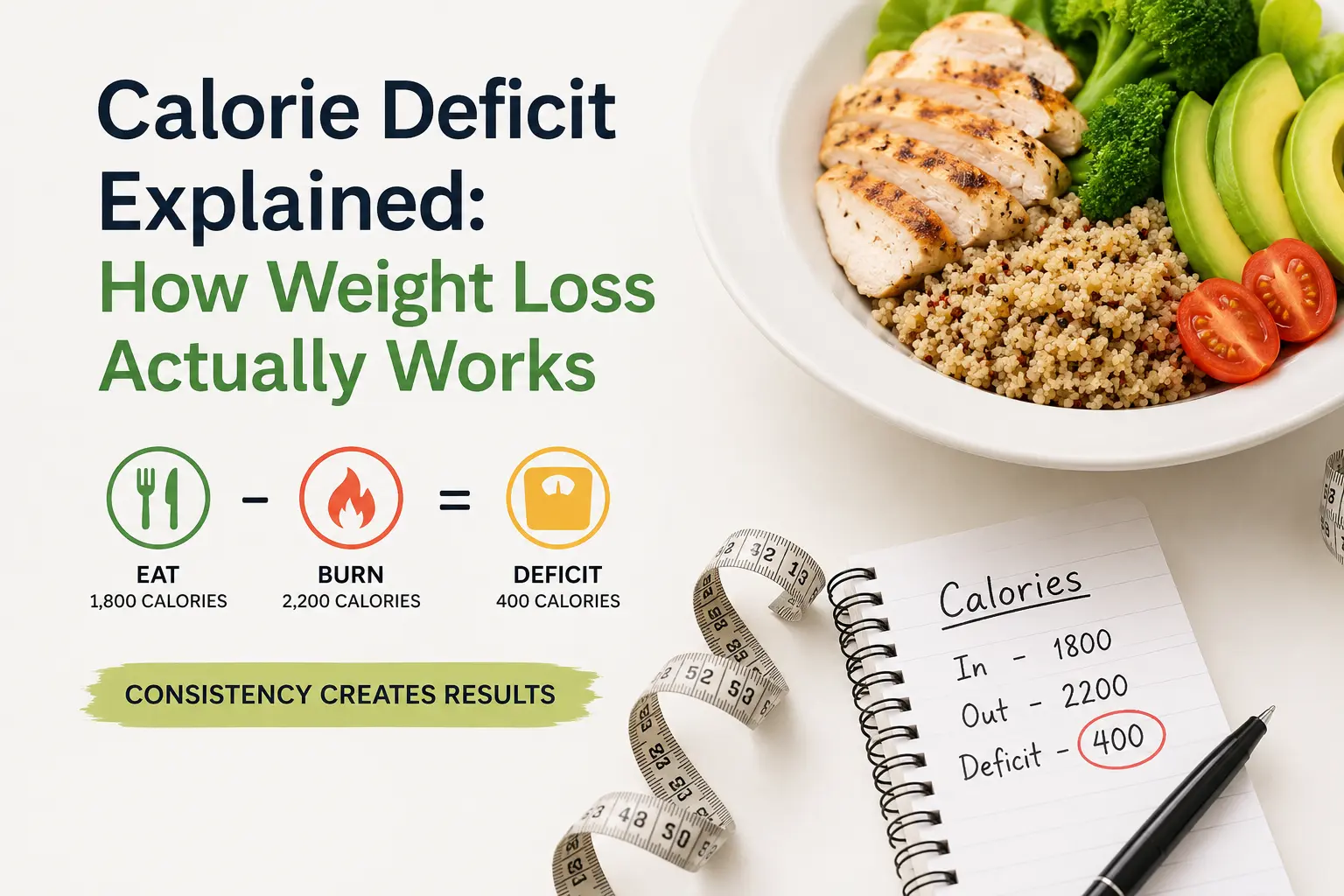
Calorie Deficit Explained: How Weight Loss Actually Works
Reading time: 14 minutes
Key Takeaways
- The non-negotiable law of fat loss: A calorie deficit occurs when you consume fewer calories than your body expends over time. No diet (keto, fasting, plant-based) causes fat loss without an underlying energy deficit.
- Metabolism is more than exercise: Total Daily Energy Expenditure (TDEE) includes Basal Metabolic Rate (BMR), Non-Exercise Activity (NEAT), Thermic Effect of Food (TEF), and Exercise (EAT). Structured workouts account for only 5–10% of total daily burn.
- Moderate deficits win long-term: A 15% to 25% daily reduction (300 to 500 kcal below maintenance) promotes steady fat loss (~0.5 kg or 1 lb per week) while protecting lean muscle and hormone balance.
- Protein preserves muscle: Consuming 1.6 to 2.2 g of protein per kg of body weight prevents muscle breakdown during a deficit and enhances satiety.
- Plateaus are normal: As body mass decreases, energy expenditure naturally drops. Plateaus are managed via diet breaks or small adjustments, not extreme starvation.
1. What Is a Calorie Deficit? (The Basic Physics)
Every discussion about fat loss begins and ends with energy balance. To understand how a calorie deficit works, you must first understand what a calorie actually is.
A calorie (specifically a kilocalorie, or kcal) is a unit of energy. It measures the heat energy required to raise the temperature of one kilogram of water by one degree Celsius. In nutrition, calories measure the chemical energy stored in food that your body metabolizes to fuel cell repair, heartbeats, brain function, and physical movement.
The First Law of Thermodynamics
Your body follows the First Law of Thermodynamics: energy cannot be created or destroyed, only transformed. When you ingest food, your body breaks down carbohydrates, fats, proteins, and alcohol into biological energy (ATP).
- Energy Surplus (Calories In > Calories Out): Excess energy is stored primarily as triglycerides in adipose (fat) tissue and secondarily as glycogen in liver and muscle cells.
- Energy Balance (Calories In = Calories Out): Body mass remains stable because energy intake equals energy expenditure.
- Calorie Deficit (Calories In < Calories Out): Energy intake is insufficient for daily biological needs. Your body mobilizes stored energy—primarily body fat—to bridge the gap.
Weight Loss vs. Fat Loss
Total scale weight includes muscle, fat, bone, organs, glycogen, and water volume.
When you first enter a calorie deficit, the initial drop on the scale often represents water and depleted glycogen. For every gram of carbohydrate stored as glycogen, your body holds 3 to 4 grams of water. Reducing calories causes a quick drop in stored glycogen and water within 48 to 72 hours.
True fat loss requires breaking down triglycerides through enzymatic lipolysis. One kilogram of human body fat contains roughly 7,700 kcal of stored energy (or ~3,500 kcal per pound). Losing one kilogram of fat requires a cumulative deficit of 7,700 kcal over time.
2. How Your Body Expends Energy (The 4 TDEE Components)
Your Total Daily Energy Expenditure (TDEE) is composed of four distinct metabolic processes:
1. Basal Metabolic Rate (BMR) ~ 60–70% of TDEE
BMR is the energy your body burns at complete rest to maintain vital functions: heart rate, brain signaling, cellular repair, respiration, and hormone synthesis. Individuals with higher muscle mass have higher BMRs because lean tissue is metabolically active at rest.
2. Non-Exercise Activity Thermogenesis (NEAT) ~ 15–20% of TDEE
NEAT includes all movement that isn't structured exercise: walking, typing, cooking, posture adjustments, standing, and fidgeting. NEAT can vary by 500 to 800 kcal per day between a sedentary desk worker and an active individual.
3. Thermic Effect of Food (TEF) ~ 10% of TDEE
TEF is the energy required to digest, absorb, and metabolize nutrients:
| Macronutrient | Digestive Cost (% of Calories Consumed) |
|---|---|
| Protein | 20% – 30% |
| Carbohydrates | 5% – 10% |
| Fats | 0% – 3% |
Eating 100 calories of protein uses 20 to 30 calories during digestion alone, making high-protein diets metabolically advantageous.
4. Exercise Activity Thermogenesis (EAT) ~ 5–10% of TDEE
EAT accounts for intentional workouts (gym sessions, running, sports). For non-athletes, structured exercise is actually the smallest component of daily energy burn.
3. How to Calculate Your Personal Calorie Deficit
Step 1: Estimate Your BMR (Mifflin-St Jeor Formula)
- Men: $\text{BMR} = (10 \times \text{weight in kg}) + (6.25 \times \text{height in cm}) - (5 \times \text{age}) + 5$
- Women: $\text{BMR} = (10 \times \text{weight in kg}) + (6.25 \times \text{height in cm}) - (5 \times \text{age}) - 161$
Example: A 32-year-old female, 70 kg, 165 cm tall: $$\text{BMR} = (10 \times 70) + (6.25 \times 165) - (5 \times 32) - 161 = 1,410 \text{ kcal/day}$$
Step 2: Determine Your TDEE (Activity Multiplier)
| Activity Level | Multiplier | Description |
|---|---|---|
| Sedentary | 1.20 | Desk job, <4,000 steps/day, no exercise |
| Lightly Active | 1.375 | Desk job + 1–3 light workouts/week |
| Moderately Active | 1.55 | Desk job + 3–5 workouts/week (~8,000 steps) |
| Very Active | 1.725 | Hard training 6–7 days/week or active job |
Using our 70 kg example with Moderately Active (1.55): $$\text{TDEE} = 1,410 \times 1.55 = 2,185 \text{ kcal/day (Maintenance)}$$
Step 3: Select Your Calorie Deficit
- Small Deficit (10–15% below TDEE): 200–350 kcal drop. ~0.25 kg fat loss/week. Highly sustainable.
- Moderate Deficit (20–25% below TDEE) [RECOMMENDED]: 400–550 kcal drop. ~0.5 kg fat loss/week. Ideal balance of speed and retention.
- Severe Deficit (30%+ below TDEE): >700 kcal drop. High risk of muscle loss, fatigue, and bingeing.
With a 20% Moderate Deficit on 2,185 kcal: $$\text{Deficit} = 2,185 \times 0.20 = 437 \text{ kcal/day}$$ $$\text{Target Intake} = 2,185 - 437 = 1,748 \text{ (1,750 kcal/day)}$$
4. Safe vs. Extreme Deficits: Why Crash Diets Fail
Dropping to 1,000–1,200 calories per day creates severe biological drawbacks:
- Muscle Catabolism: Wide energy gaps cause your body to breakdown skeletal muscle for amino acids via gluconeogenesis, reducing long-term BMR.
- Hormonal Disruptions: Leptin (satiety) and active thyroid hormone ($T_3$) plummet, while ghrelin (hunger) and cortisol surge.
- NEAT Downregulation: Your nervous system subconsciously cuts fidgeting, walking speed, and posture movement to save energy.
- The Binge Cycle: Extreme hunger eventually triggers overeating episodes, causing rapid fat regain while leaving you with less muscle mass than when you started.
5. The Critical Role of Macronutrients
Counting total calories determines how much weight you lose; managing macronutrients determines what type of tissue you lose.
- Protein (1.6 to 2.2 g/kg of body weight): Protects muscle mass from breakdown during energy scarcity, promotes satiety through gut peptides (GLP-1, PYY), and carries the highest thermic cost.
- Dietary Fats (0.7 to 1.0 g/kg of body weight): Essential for sex hormone synthesis (testosterone, estrogen), cell integrity, and absorption of vitamins A, D, E, and K. Keep fat at 20–30% of total calories.
- Carbohydrates (Remaining Calories): Fuels glycogen stores, high-intensity strength training, thyroid function, and mood. Complex fiber-rich carbs (oats, sweet potatoes, legumes, berries) stabilize energy levels.
6. Why You Aren't Losing Weight in a "Calorie Deficit"
If scale weight remains stuck over 3+ weeks, one of four tracking or physiological phenomena is happening:
1. Tracking Errors & Hidden Calories
Untrained tracking undercounts food intake by up to 30%. Unmeasured cooking oil (120 kcal/tbsp), salad dressings, peanut butter, and unlogged snacks can easily eliminate a 400-calorie deficit.
2. Overestimating Workout Calories
Fitness trackers overestimate exercise burn by 20–40%. Eating back smart-watch "burned calories" often cancels out your real deficit.
3. Weekend Surplus Erasing Weekday Progress
Eating 1,600 kcal Mon–Thu (-2,000 kcal weekly deficit) followed by 2,800 kcal Fri–Sun (+2,100 kcal weekly surplus) results in a net surplus, preventing weight loss.
4. Fluid Retention Masking Fat Loss
Elevated cortisol from dieting, inflammatory muscle repair from workouts, or sodium shifts cause temporary water retention. You may be losing body fat continuously while fluid holds the scale flat for 2 to 3 weeks until a sudden "flush" drop occurs.
7. Metabolic Adaptation & Weight Loss Plateaus
As you lose body mass, your TDEE naturally decreases because:
- Carrying a lighter body requires less energy for movement.
- Less total tissue translates to a lower baseline BMR.
- Eating less total food reduces TEF.
- Subconscious NEAT drops as your body conserves energy.
How to Break a Plateau:
- Weigh food on a digital scale for 7 days to eliminate tracking errors.
- Re-calculate your TDEE using your new lower body weight.
- Increase daily step count (e.g., from 6,000 to 9,000 steps) to boost NEAT.
- Take a 1-to-2 week Diet Break at maintenance calories to normalize ghrelin/leptin hormones before resuming your cut.
8. Exercise vs. Diet: Which Matters More?
Creating a 500-calorie deficit via diet requires minor adjustments (reducing a tablespoon of oil, swapping sugary coffee for black coffee). Creating a 500-calorie deficit via exercise requires running ~5.5 km (3.5 miles) at a sustained pace. Diet is far more efficient for creating the energy gap.
However, resistance training (lifting weights) is essential. While cardio burns energy, weightlifting provides the mechanical stimulus that signals your body to preserve muscle tissue and burn fat instead.
9. Practical Satiety Strategies: How to Stay Full
- High-Volume, Low-Density Foods: Fill half your plate with watery, fiber-rich vegetables (leafy greens, cucumbers, zucchini, berries). Stretch receptors in your stomach trigger fullness without adding excess calories.
- Intact Fiber (25–38g daily): Chia seeds, flaxseeds, legumes, and oats delay gastric emptying and sustain satiety.
- Pre-Meal Water Protocol: Drinking 500 mL of water 15 minutes before meals expands stomach volume, naturally reducing calorie intake.
10. Tracking Smart: Where AI Food Logging Fits In
Manual food logging can feel tedious, leading to abandoned tracking habits.
Modern tools like Pulze use AI visual and voice recognition to estimate meal calories, portion weights, and macros in seconds. By focusing on your 7-day average calorie deficit rather than daily perfection, you can maintain consistency and achieve long-term fat loss.
11. Frequently Asked Questions (FAQ)
Can I build muscle in a calorie deficit?
Yes. Body recomposition is possible for beginners, people returning after a break, or those with higher body fat. Keep your deficit moderate (15–20%), protein high (1.8–2.2 g/kg), and strength train progressively.
Is "Starvation Mode" real?
No. While metabolic rate slows during weight loss, your body cannot stop burning energy altogether. If you are in a true energy deficit, your body will oxidize stored tissue. Stalled weight is almost always caused by uncounted calories or water retention.
Should I eat back my exercise calories?
No. Activity multipliers in TDEE already account for workouts. Eating back tracker calories often leads to overconsumption.
How long should a calorie deficit phase last?
Keep deficit phases between 8 to 16 weeks, followed by 2 to 4 weeks at maintenance calories to prevent fatigue and hormone suppression.
Does eating late at night cause weight gain?
No. Energy balance is calculated over 24+ hour periods. Timing matters far less than total daily intake relative to TDEE.
12. Final Thoughts & Next Steps
Successful fat loss relies on energy balance physics, not fad diets:
- Calculate your realistic TDEE.
- Set a 15–25% calorie deficit.
- Consume 1.6–2.2 g/kg of protein and strength train.
- Focus on high-volume, whole foods.
- Use smart tools like Pulze to track consistency over time.