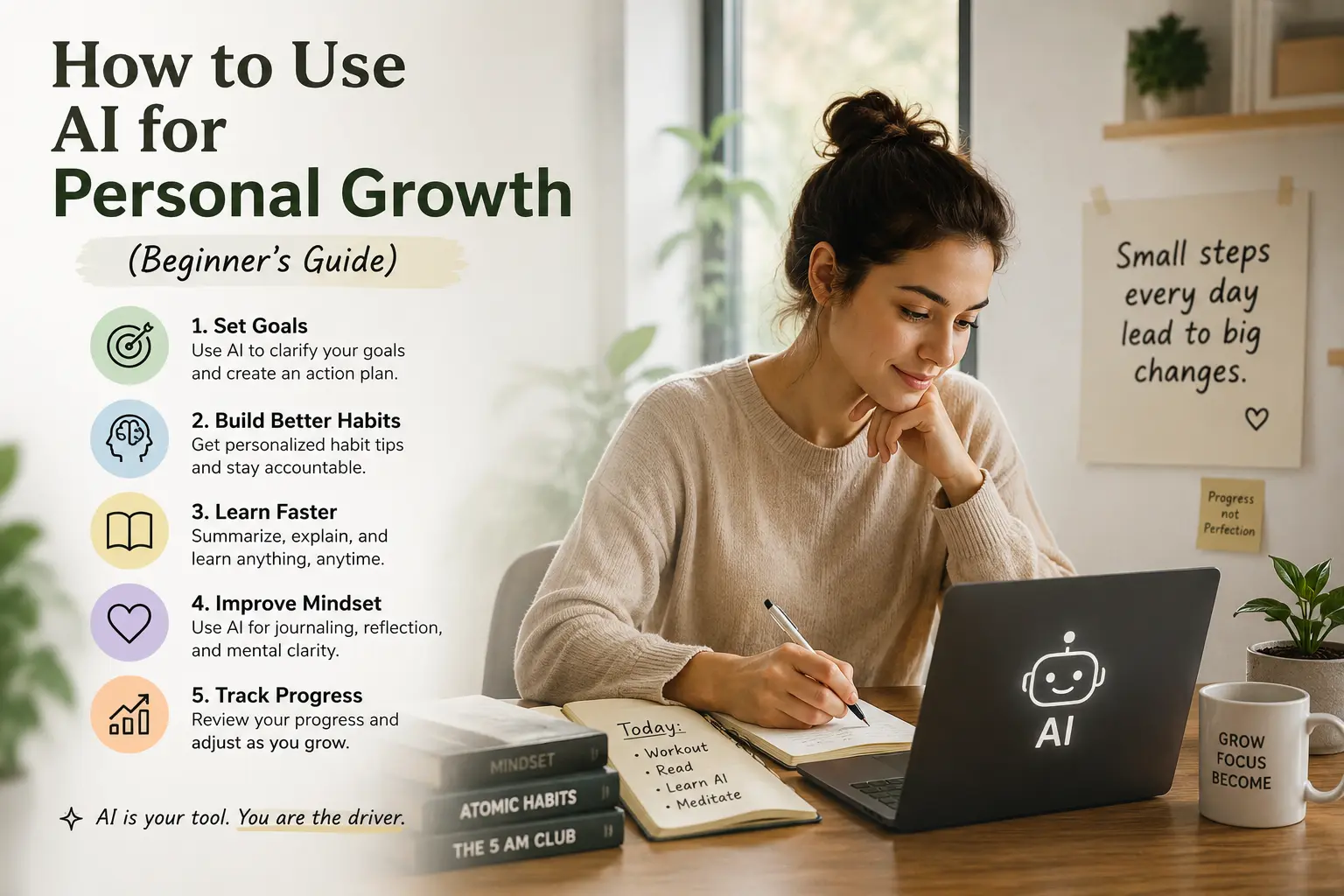
How to Use AI for Personal Growth (Beginner's Guide)
Reading time: 12 minutes
[!NOTE] Key Takeaways
- AI is more than a writing tool; it can act as a personalized coach for learning and habit building.
- The goal of AI is not to replace human effort, but to remove friction from your daily workflows.
- Traditional productivity fails when motivation fades, but AI helps adapt your systems dynamically.
- Start small: integrate AI into one part of your daily routine before expanding.
Introduction
Most people think of artificial intelligence simply as a tool to write emails, generate code, or draft marketing copy. While it excels at those tasks, treating AI strictly as a content machine misses its true potential.
When used thoughtfully, AI can become a dedicated personal coach for learning, productivity, planning, and habit building.
Imagine having an assistant who knows your schedule, understands how you learn best, and gently nudges you toward your goals without judgment. That is the reality of AI personal growth today.
The goal isn't replacing human effort or taking shortcuts. Growth still requires you to show up, do the work, and reflect on your progress. The goal is removing friction. By using AI to clear away the clutter, organize your thoughts, and simplify complex problems, you free up the mental energy needed to actually improve yourself.
What Is AI for Personal Growth?
AI for personal growth is the practice of using artificial intelligence to optimize how you learn, plan, and execute your daily goals.
Unlike traditional software that only stores the information you give it, modern AI actively interacts with your data to help you achieve better outcomes.
When applied to self improvement, AI typically helps in the following areas:
- Learning faster: Breaking down complex topics into simple analogies.
- Better planning: Organizing messy thoughts into actionable steps.
- Better decision making: Acting as an objective sounding board for difficult choices.
- Habit tracking: Recognizing patterns in your behavior to suggest adjustments.
- Productivity: Automating the tedious parts of your workflow so you can focus on deep work.
- Reflection: Asking insightful questions to improve your daily journaling.
In short, AI for personal growth is about setting up systems that make it easier for you to succeed.
Why Traditional Productivity Systems Often Fail
We have all been there. You download a new task manager, spend hours color-coding your projects, and promise yourself that this time you will stick to the plan. Two weeks later, the app is gathering dust.
Why does this happen so often?
- Motivation fades: Traditional systems rely entirely on your discipline. On days when you are tired, a rigid to-do list feels overwhelming rather than helpful.
- Too many apps: Switching between a calendar, a habit tracker, a notes app, and a task manager creates unnecessary friction.
- Information overload: We collect more articles and bookmarks than we could ever read, creating anxiety instead of knowledge.
- Inconsistent habits: Life is unpredictable. Rigid systems break when your schedule changes unexpectedly.
- Lack of feedback: A paper planner cannot tell you why you keep missing your morning workouts.
AI helps reduce these problems by adapting to you. Instead of forcing you to fit into a rigid template, an AI workflow can restructure your tasks when you fall behind, summarize your reading list, and provide objective feedback on your habits.
8 Practical Ways to Use AI for Personal Growth
To get the most out of AI, you need to apply it to specific bottlenecks in your life. Here are eight practical ways to use AI for self improvement.
1. Daily Planning
Problem: You start the day feeling overwhelmed by a massive list of tasks and don't know where to begin. AI Solution: Ask AI to prioritize your list based on urgency, energy levels, and time constraints. Real Example: Paste your scattered to-do list into an AI chat and prompt: "Here is everything I need to do today. I have 4 hours of deep work time and 2 hours of low energy. Please create a realistic schedule for me."
2. Learning Faster
Problem: You are trying to learn a complex topic, but the textbooks and articles are too dense. AI Solution: Use AI as a personalized tutor to explain concepts using analogies that make sense to you. Real Example: "I am trying to understand how the stock market works. Please explain it to me as if I am a 12-year-old who understands trading baseball cards."
3. Habit Building
Problem: You want to start reading every night, but you keep forgetting or feeling too tired. AI Solution: Ask AI to design a micro-habit progression plan. Real Example: "I want to read more books but struggle with consistency. Create a 30-day plan that starts with just 2 minutes of effort a day and gradually scales up."
4. Journaling
Problem: You stare at a blank page and don't know what to write about. AI Solution: Use AI to generate personalized journaling prompts based on your current mood or challenges. Real Example: "I am feeling anxious about a big presentation next week. Ask me three deep questions to help me process this anxiety in my journal."
5. Brainstorming
Problem: You are stuck on a creative project and can't find a good angle. AI Solution: Treat the AI as a collaborative partner rather than a search engine. Have a back-and-forth conversation to generate ideas. Real Example: "I need to write a blog post about productivity for students. Give me 10 unconventional angles that haven't been overdone."
6. Time Management
Problem: You constantly underestimate how long tasks will take. AI Solution: Have AI review your project requirements and break them down into realistic time blocks. Real Example: "I need to clean my garage this weekend. Break this down into 30-minute chunks so I don't get overwhelmed."
7. Career Growth
Problem: You want to ask for a raise or prepare for an interview, but you feel nervous. AI Solution: Roleplay difficult conversations with an AI to practice your responses. Real Example: "Act as a tough hiring manager interviewing me for a project manager role. Ask me one question at a time and critique my answers."
8. Decision Making
Problem: You are stuck between two difficult choices and keep going in circles. AI Solution: Ask AI to build a structured pros and cons matrix or run a mental model for you. Real Example: "I am deciding whether to move to a new city for a job or stay near my family. Walk me through the 'Regret Minimization Framework' to help me decide."
Build an AI Daily Routine
Integrating AI into your life works best when it becomes part of your natural rhythm. Here is what a simple AI daily routine might look like.
Morning: Clarity and Focus
Instead of scrolling social media, open your AI tool of choice. Dump all the random thoughts, worries, and tasks floating in your head into the chat. Ask the AI to organize them into a clear, three-item priority list for the day. This takes less than five minutes but sets a calm, focused tone.
Afternoon: Overcoming Blocks
When you hit a midday slump or get stuck on a difficult task, use AI to unblock yourself. Whether you need a quick summary of a long document, a fresh perspective on a problem, or just a simplified breakdown of your next step, AI acts as an on-demand sounding board to keep your momentum going.
Evening: Reflection and Preparation
At the end of the day, use AI to process your experiences. You can dictate a quick voice note about how the day went and ask the AI to summarize your wins and areas for improvement. Finally, ask it to draft a rough schedule for tomorrow based on what you didn't finish today.
Mistakes to Avoid
While AI is incredibly powerful, relying on it too heavily can hinder your personal growth. Watch out for these common traps.
- Using AI for everything: If you let AI write your personal apologies or do your deep thinking, you lose your own voice and cognitive skills.
- Copy-pasting answers: Real growth comes from understanding. If you just copy an AI's output without studying it, you aren't actually learning.
- Ignoring critical thinking: AI makes mistakes and hallucinates facts. Always verify important information and trust your own judgment.
- Using too many AI tools: You don't need a different AI app for notes, habits, writing, and scheduling. Find one or two reliable tools and stick with them.
- No clear goals: AI is a multiplier. If you don't know what you want to achieve, AI will just help you procrastinate more efficiently.
Best AI Tools for Personal Growth
The market is flooded with tools, but for personal growth, you only need a few reliable options. Here are some of the best AI productivity tools available right now.
- ChatGPT: The best all-around assistant. It is excellent for brainstorming, roleplaying conversations, and organizing messy thoughts.
- Claude: Known for its highly natural and conversational tone. Claude is exceptional at summarizing long documents and assisting with deep, reflective writing.
- Gemini: Deeply integrated with Google Workspace. It is great if you want to pull information seamlessly from your emails and documents.
- Notion AI: Perfect for those who already use Notion for note-taking. It helps summarize meeting notes, organize databases, and generate writing directly within your workspace.
- Perplexity: A powerful AI search engine. Instead of giving you a list of blue links, it reads the internet and gives you cited, well-researched answers. Great for learning.
- Grammarly: Beyond just spelling, its AI features help ensure your communication is clear, confident, and appropriately toned.
The Future of AI Personal Growth
We are just scratching the surface of what is possible. The next phase of AI for self improvement will move beyond simple chat interfaces.
Soon, we will see personalized coaching systems that understand your long-term goals and gently correct your course over months and years.
Expect the rise of daily AI assistants that proactively organize your schedule before you even ask, and learning companions that adapt their teaching style in real-time as they watch you solve problems.
We will also see more productivity games—systems that use AI to dynamically balance the difficulty of your daily tasks, keeping you engaged and in a state of flow without burning out.
The future isn't about AI doing the work for you; it is about AI helping you become the best version of yourself.
Build Better Habits, One Day at a Time
At Pulze, we're exploring simple AI-powered experiences that help people improve their productivity, learning, and daily habits through focused apps and interactive challenges.
We believe that personal growth shouldn't feel like a chore. That is why we are building productivity apps and games designed to make self-improvement engaging and sustainable. Whether you are a student trying to build a study routine or a professional looking to optimize your workflow, the goal is always the same: removing the friction between where you are and where you want to be.
To explore what we are building, check out our latest apps or read more about our philosophy on our about page.
FAQ
What is AI for personal growth?
AI for personal growth involves using artificial intelligence to optimize your learning, daily planning, habit tracking, and decision-making processes. It acts as a digital coach to help you achieve your goals with less friction.
Can AI improve productivity?
Yes. AI improves productivity by automating repetitive tasks, summarizing information quickly, and helping you break down large, overwhelming projects into manageable, time-blocked steps.
Can AI replace habit trackers?
While AI won't entirely replace the need to track your habits, it enhances traditional trackers by analyzing your data, identifying why you might be failing, and suggesting realistic adjustments to keep you on track.
Is AI good for students?
AI is highly beneficial for students. It can act as a personalized tutor, explain complex concepts through simple analogies, generate practice quizzes, and help organize study schedules.
Can AI help me stay focused?
AI can help you stay focused by organizing your priorities and removing distractions. By acting as a sounding board, it prevents you from getting stuck on minor details, allowing you to maintain momentum.
What are the best AI productivity tools?
The best tools depend on your needs, but popular options include ChatGPT for general brainstorming, Claude for natural writing and summarizing, Perplexity for research, and Notion AI for workspace organization.
How should beginners start using AI?
Beginners should start small. Pick one bottleneck in your day—like prioritizing your morning to-do list or summarizing long emails—and use an AI tool to assist with just that one task before expanding.
Is using AI every day a good idea?
Using AI daily is a good idea as long as it is used to enhance your workflow, not replace your critical thinking. Treat it as a collaborative partner rather than a crutch that does all the work for you.
Conclusion
Using AI for personal growth is not about turning yourself into a hyper-productive machine. It is about clearing away the mental clutter so you can focus on the things that actually matter.
Whether you are trying to learn a new skill, build a better morning routine, or simply get through your workday with less stress, AI can provide the structure and feedback you need to succeed.
The key is to start small. Don't try to automate your entire life overnight. Pick one small area—like your morning planning or your evening journaling—and invite AI into the process. Over time, these small optimizations will compound, helping you build better habits and achieve your goals with ease.