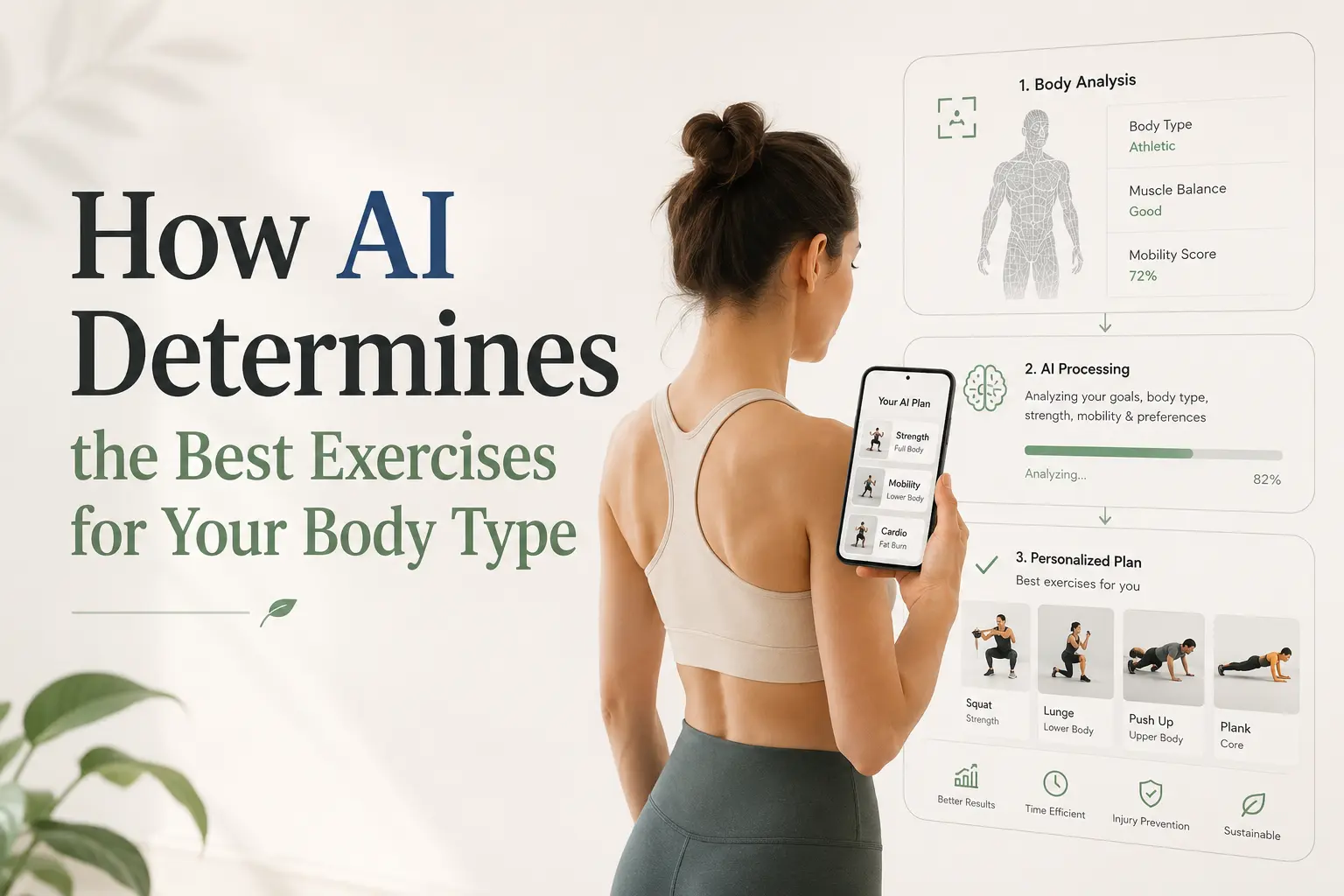
How AI Determines the Best Exercises for Your Body Type
Reading time: 15 minutes
Introduction
Have you ever copied someone else's workout routine only to see little or no progress? Maybe you tried the exact leg day routine your favorite fitness influencer posted, but instead of gaining strength, you just ended up with sore knees and frustration.
The truth is that no two bodies respond exactly the same way to exercise. A squat stance that feels perfect for your workout partner might feel completely unnatural and painful for you.
That's where artificial intelligence is changing fitness. We are stepping away from the era of "one-size-fits-all" workout PDFs and entering an age where your training program is built specifically for you. By analyzing vast amounts of data—from your current mobility to your daily recovery—an AI workout planner can determine exactly which exercises will give you the best results.
In this guide, we will explore exactly how an AI fitness coach understands your unique physiology, why personalization matters, and how algorithms are helping everyday people train smarter.
What Does "Body Type" Actually Mean?
When most people hear the phrase "body type," they immediately think of the three classic somatotypes: ectomorph (naturally thin), mesomorph (naturally muscular), and endomorph (naturally broader).
While these categories offer a very basic framework, modern exercise science and AI look far beyond them. True body type is a complex combination of several individual factors.
Genetics and Muscle Distribution
Your genetic makeup plays a massive role in how you build muscle and lose fat. Some people naturally have dominant quads, while others might have a stronger posterior chain (glutes and hamstrings). An AI fitness app considers your natural strengths and weaknesses to balance your physique.
Mobility and Biomechanics
We all have different limb lengths. A person with very long femurs (thigh bones) will struggle to maintain an upright torso during a traditional barbell back squat. For them, a front squat or a leg press might be far more effective and safer. Mobility restrictions in the ankles, hips, or shoulders also dictate which exercises are safe for you to perform.
Previous Injuries
Your medical history shapes your physical capabilities. If you have a history of lower back pain, heavy deadlifts might not be the best starting point. Your "body type" in this context is a body that requires spinal stabilization and core-focused alternatives before loading the spine heavily.
Training Experience
A beginner's body responds differently to stress than an advanced lifter's body. A novice might see incredible gains from doing three basic exercises a few times a week, while a veteran gym-goer might need complex periodization to break through a plateau.
Goals and Lifestyle
Are you trying to run a 5K, or are you trying to build muscle mass? Do you sit at a desk for 10 hours a day, or do you have a physically demanding job? These lifestyle factors directly impact your energy levels, posture, and recovery capacity.
Why Generic Workout Plans Often Fail
If you search for a workout online right now, you will likely find thousands of templates. So, why do they fail so many people?
Everyone Recovers Differently
A generic program might tell you to train legs on Monday and Thursday. But what if you work construction and are on your feet all day? Your central nervous system and leg muscles might need 72 hours to recover, not 48. If you force yourself to follow the template, you risk overtraining.
Different Strengths and Weaknesses
Templates assume a baseline level of strength across all muscle groups. If a program prescribes unassisted pull-ups, but you haven't developed the back strength to do one yet, you are stuck. You need a program that starts you on inverted rows or lat pulldowns and gradually bridges the gap.
Different Flexibility Levels
A standard plan might include deep overhead squats. If you lack shoulder and thoracic mobility, attempting this movement will force your body to compensate, likely straining your lower back. Generic plans don't know you can't raise your arms straight up without arching your spine.
Schedule Conflicts
Life is unpredictable. A PDF workout plan requires you to hit the gym for 60 minutes, five days a week. If you miss a day, the whole schedule falls apart. You feel guilty, skip the next day, and suddenly you have abandoned the program entirely.
By ignoring these critical human variables, generic workout templates often lead to burnout, injury, or simply a lack of motivation.
How AI Builds Personalized Workout Plans
Unlike a static template, an AI workout planner is dynamic. It treats your fitness journey as a continuous loop of feedback and adjustment. Here is a step-by-step look at how the process actually works.
1. Collecting User Information
The process starts with an intake questionnaire. The AI asks about your age, weight, goals, available equipment, and fitness background. This builds your initial profile.
2. Analyzing Fitness Level
Many AI apps use an initial assessment phase. It might ask you to perform a simple strength test, like maximum push-ups in a minute, or log the weights you use for your first few sessions. This establishes your baseline.
3. Understanding Goals
The AI translates your human goals ("I want to tone up") into physiological targets (hypertrophy and fat loss). It then maps out the scientific pathways needed to get there.
4. Learning Preferences
If you hate running on a treadmill, the AI learns this. It will swap steady-state treadmill cardio for high-intensity kettlebell swings or rowing, ensuring you actually enjoy the workouts you are prescribed.
5. Tracking Progress
Every time you log a workout, the AI captures data. It notes how many reps you completed, how much weight you lifted, and sometimes even how hard the session felt (your Rate of Perceived Exertion, or RPE).
6. Adjusting Workouts Over Time
If the AI notices you easily hit 15 reps on a weight you previously struggled to lift 10 times, it will automatically increase the weight or difficulty for your next session. If you log poor sleep or high stress, it might lower the intensity to protect your recovery.
What Data AI Uses
To make these intelligent decisions, fitness AI relies on a massive influx of data points. Every piece of information helps paint a complete picture of your body type and current state.
Age, Gender, Height, and Weight
These basic metrics help the AI calculate your basal metabolic rate (BMR) and establish baseline strength expectations.
Body Fat Percentage
Knowing your body composition helps the algorithm prioritize either muscle building or calorie burning.
Mobility and Exercise History
Your history dictates your starting line. A former high school athlete returning to the gym needs a different ramp-up period than someone who has never touched a dumbbell.
Workout Frequency and Equipment
The AI builds your program around the days you can actually commit to and the equipment you have access to. A three-day dumbbell home workout looks vastly different from a five-day fully equipped commercial gym split.
Sleep, Recovery, and Nutrition
Advanced AI integrates with health apps to track your sleep duration and heart rate variability (HRV). If your HRV drops—a sign of under-recovery—the AI knows you need a lighter day.
Heart Rate and Wearable Devices
Data from Apple Watches or Garmins tells the AI exactly how hard your cardiovascular system is working. It ensures your "easy run" is actually easy and your "sprint intervals" are genuinely intense.
Machine Learning Explained Simply
To understand how AI creates these workouts, it helps to understand machine learning—without the complicated computer science terms.
Think about how Netflix recommends movies. When you first create an account, Netflix doesn't know much about you. It suggests a broad mix of popular shows. If you watch three science fiction movies and give them a thumbs up, the algorithm learns. The next time you log in, your homepage is filled with sci-fi thrillers.
Spotify works the same way. It looks at the thousands of songs you skip and the hundreds you play on repeat. It compares your habits to millions of other users with similar tastes to build your "Discover Weekly" playlist.
An AI fitness coach does the exact same thing, but with exercise.
When you start, it gives you a well-rounded baseline routine. If you consistently struggle to finish the final sets of your chest exercises, the AI takes note. It compares your performance data against thousands of other users who faced similar struggles. The algorithm then adjusts your volume, perhaps lowering the sets or changing the exercise angle, until it finds the "playlist" of exercises that your body responds to perfectly.
How AI Chooses Exercises
So, you arrive at the gym, open your app, and see your workout for the day. Why did the AI choose these specific movements for you?
Prioritizing Compound Movements
For most people, the AI will prioritize compound exercises—movements that work multiple muscle groups at once. If your goal is general fitness and you only have 45 minutes, the AI will give you exercises like squats, deadlifts, and overhead presses because they offer the most return on your time investment.
Integrating Isolation Exercises
Once the heavy lifting is done, the AI fills in the gaps with isolation exercises. If your data shows your triceps are holding back your bench press progress, the AI will program tricep extensions specifically to target that weak point.
Matching Biomechanics
This is where the magic happens. Let's look at two users, John and Sarah. Both want to build leg strength.
- John is tall, has limited ankle mobility, and a history of lower back stiffness. The AI prescribes Goblet Squats for John. Holding the weight in front allows him to stay upright, protecting his back while working his legs.
- Sarah has great mobility, a strong core, and has been lifting for a year. The AI prescribes Barbell Back Squats for Sarah, knowing her body can handle the heavier load safely.
Both are squatting, but the AI selected the specific variation that matches their unique body type and capabilities.
Managing Progressive Overload
To grow stronger, you must gradually challenge your body. This is called progressive overload. The AI handles the math for you. It knows exactly when you should lift five more pounds, add one more rep, or shorten your rest periods.
Can AI Adapt Over Time?
A common misconception is that AI just spits out a 12-week program and leaves you to it. In reality, the best AI gym apps utilize adaptive learning.
Week 1: The Baseline
During your first week, the AI is testing the waters. It might prescribe conservative weights to see how your body reacts. You log your workouts, noting that the lunges felt a bit too easy, but the push-ups were very difficult.
Week 4: The Adjustment
By week four, the AI has enough data to refine your path. It swaps traditional push-ups for incline push-ups so you can complete the full range of motion. It also increases the dumbbell weight on your lunges because it recognized you adapt quickly to lower body volume.
Week 12: The Evolution
Three months in, your body has changed. You have lost fat and gained muscle. Your resting heart rate has dropped. The AI recognizes you are no longer a beginner. It automatically transitions your programming from basic foundational movements to more advanced hypertrophy blocks, perhaps introducing supersets or drop sets to keep challenging your new body type.
Benefits of AI Workout Personalization
Embracing workout personalization through technology offers incredible advantages.
- Better Consistency: When a workout is built around your schedule and preferences, you are far more likely to stick with it.
- Reduced Injuries: By avoiding exercises that don't fit your biomechanics and adjusting volume based on your recovery, AI keeps you healthy.
- Less Guesswork: You never have to wander around the gym wondering what to do next. The plan is laid out, optimized, and ready.
- Faster Progress: Because every set and rep is calibrated to your specific threshold, you stop wasting time on "junk volume" that doesn't trigger growth.
- Improved Recovery: Smarter programming means you aren't constantly destroying your muscles. You train just enough to stimulate change, then allow your body to heal.
- Dynamic Flexibility: If you usually train at a full gym but only have dumbbells today while traveling, the AI instantly recalculates your workout using available equipment.
Limitations
As incredible as fitness AI is, it is important to be honest about its current limitations.
Poor Input Equals Poor Output
An AI is only as smart as the data you give it. If you lie about how many reps you completed, or if you say a workout felt easy when you were actually struggling, the algorithm will give you bad recommendations.
It Doesn't Replace Medical Advice
If you have a serious medical condition, an acute injury, or require physical therapy, an AI cannot diagnose or treat you. You still need human medical professionals.
Form Monitoring
While some advanced apps are introducing computer vision, most AI planners cannot see your form. The app might tell you to deadlift 135 lbs, but it relies on you to maintain a safe, neutral spine while doing it.
AI vs Personal Trainers
A common question is whether AI will completely replace human personal trainers. The short answer is no. They serve different purposes and excel in different areas.
Where AI Excels:
- Data Crunching: An AI can instantly analyze months of data, cross-reference it with sports science literature, and calculate perfect volume adjustments in milliseconds. A human simply cannot process math that fast.
- Cost and Accessibility: Personal trainers can cost $50 to $150 per hour. An AI fitness app provides elite-level programming for a fraction of that cost, available 24/7 in your pocket.
Where Humans Excel:
- Emotional Support: A human trainer can look in your eyes, see that you've had a terrible day at work, and talk you through a mental block. AI cannot replicate genuine empathy.
- Nuanced Form Correction: A trainer can physically guide your elbow into the right position or notice subtle imbalances in your posture that don't translate into logged data.
For the vast majority of gym-goers, an AI workout planner provides 90% of the value of a trainer at 10% of the cost, making it an incredibly powerful tool.
Best Practices
To get the absolute best exercise recommendations for your body type, you need to work with the AI. Here is how you can maximize your results:
- Be Brutally Honest: When setting up your profile, don't exaggerate your activity level. If you sit at a desk all day, say so.
- Log Everything Promptly: Don't wait until the end of the week to log your workouts. Log your reps and weights immediately after each set while the memory (and the fatigue) is fresh.
- Use the Feedback Tools: If an exercise causes joint pain, use the app's feature to swap it out or flag it. The AI will learn to avoid that movement pattern for you.
- Track Your Recovery: Sync your smartwatch if possible. Let the AI see your sleep data and resting heart rate.
- Update Your Body Metrics: Weigh yourself regularly and update the app. As your body type shifts, your nutritional and training needs will shift too.
Future of AI Fitness
We are only scratching the surface of what machine learning fitness can do. In the near future, the integration of AI and exercise will become even more seamless.
Computer Vision
Using your smartphone's camera, future AI apps will monitor your form in real-time. If your knees cave in during a squat, the app will instantly give you an audio cue to push your knees out, essentially acting as a live spotter.
Complete Health Integration
Upcoming systems will merge your workout data with your nutritional intake, blood work, and genetic testing. Your AI coach will know exactly what macronutrient split you need to fuel the specific muscle fibers you are training that day.
Predictive Recovery
Instead of reacting to your fatigue, AI will predict it. By analyzing stress trends, weather, and sleep patterns, it will know you are likely to catch a cold or pull a muscle before it happens, automatically shifting you into a proactive deload week.
Conclusion
Understanding your body type is about much more than categorizing yourself into a broad, outdated label. Your body is a highly specific combination of genetics, mobility, history, and daily habits.
Generic workout templates assume everyone is the same, which is why they so often lead to plateaus and frustration. Artificial intelligence changes the game by analyzing your unique data and applying the principles of progressive overload specifically to your capabilities.
By using machine learning to understand how you recover, which exercises fit your biomechanics, and how you adapt to stress, an AI workout planner takes the guesswork out of fitness.
If you are tired of copying influencer workouts and wondering why you aren't seeing results, it is time to let data drive your decisions. Modern AI applications are making elite-level, personalized coaching accessible to everyone, ensuring that training can be optimized for your body.
Frequently Asked Questions
1. Do I need to be tech-savvy to use an AI fitness app? Not at all. Modern AI fitness platforms are designed to be user-friendly. You simply answer questions, follow the instructions on the screen, and log your sets. The complex algorithms work entirely behind the scenes.
2. How fast will I see results with an AI workout planner? Because the workouts are optimized for your specific recovery capacity and strength levels, many users feel stronger within the first two weeks. Visible physical changes generally take 6 to 8 weeks of consistent training and proper nutrition.
3. Can AI build workouts for home gyms with limited equipment? Yes. One of the biggest advantages of AI is its adaptability. You can tell the app exactly what equipment you have (e.g., just two dumbbells and a resistance band), and it will calculate the best exercises for your body type using only those tools.
4. Will AI force me to do exercises I hate or that cause pain? No. High-quality AI platforms allow you to flag exercises that cause discomfort or that you simply dislike. The algorithm will immediately suggest alternatives that target the same muscle groups without the pain.
5. How does AI know if I am lifting too heavy? The AI tracks your performance over time. If it predicts you should be able to lift 100 lbs for 10 reps based on past data, but you log that you failed at 5 reps, the system recognizes the weight is too heavy and will automatically adjust it down for your next session.
6. Is an AI workout plan safe for beginners? Yes, AI is excellent for beginners because it removes the guesswork. It starts you at an appropriate baseline, prioritises foundational movements, and only increases difficulty when the data proves your body is ready for it, vastly reducing the risk of injury.
7. Does AI consider my age when choosing exercises? Absolutely. Age impacts recovery rates and joint resilience. The AI factors your age into its calculations, often prioritizing mobility work and adjusting overall volume to ensure older adults can train intensely without overtaxing their joints.