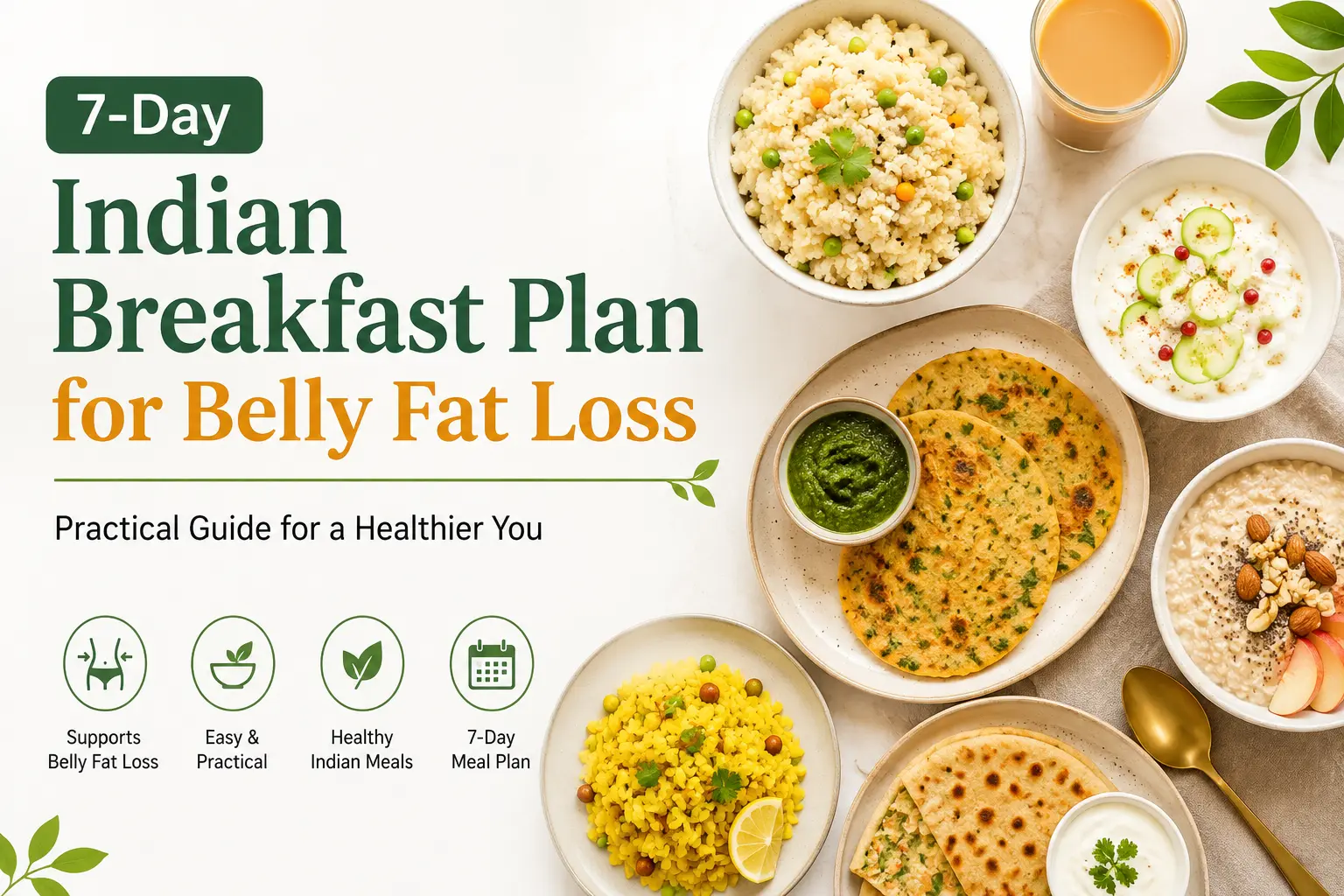
7-Day Indian Breakfast Plan for Belly Fat Loss (Practical Guide)
Reading time: 10 minutes
Key Takeaways
- Spot reduction is a myth: No specific Indian breakfast food directly burns belly fat. Fat loss happens across the body when you maintain a consistent calorie deficit.
- Protein and fiber drive satiety: A high protein Indian breakfast with adequate fiber keeps you full, reducing mid-morning snack cravings and making calorie control easy.
- Traditional foods fit easily: You do not need to give up idli, dosa, poha, upma, or eggs. Adjusting the ratio of protein to carbohydrates is usually all it takes.
- Preparation matters: A teaspoon of oil versus three tablespoons of ghee changes the calorie density of your morning meal completely.
- Consistency over perfection: Long-term fat loss comes from your total weekly energy balance, movement, sleep, and daily habits.
Most Indian weight loss diets fail for one simple reason: they ask you to eat foods you did not grow up eating. When someone tells an Indian household to swap warm idlis or poha for avocado toast or expensive smoothies, the diet usually lasts four days. By Thursday morning, you are back to your usual breakfast, feeling like you lack discipline.
If you are searching for a 7-Day Indian Breakfast Plan for Belly Fat Loss, you do not need to abandon your kitchen. Traditional Indian breakfasts are full of nutrient-dense lentils, fermented batters, whole grains, and spices. The main challenge in standard Indian morning meals is not the ingredients, but the balance. A typical plate is often 80% carbohydrates and low in protein, leading to a quick blood sugar spike followed by hunger at 11:00 AM.
By restructuring your plate—adding quality protein, increasing fiber, and keeping added oil in check—you can enjoy a healthy Indian breakfast that supports steady fat loss while keeping you satisfied until lunch.
Can Breakfast Help Reduce Belly Fat?
Before looking at the plan, let us clear up a major myth: no food or breakfast recipe directly burns belly fat.
When your body burns stored fat for energy, it mobilizes fat from across your entire body based on genetics, age, and hormones. You cannot choose to lose fat exclusively from your abdomen.
However, your breakfast plays a strategic role in overall weight management:
- Controls Daily Calorie Intake: A low calorie Indian breakfast rich in protein and fiber prevents mid-morning hunger. You are far less likely to reach for office biscuits, samosas, or sugary chai at 11:30 AM.
- Preserves Lean Muscle Mass: A high protein Indian breakfast helps preserve muscle tissue while you lose body fat, keeping your metabolic rate healthy.
- Sustains Energy Levels: Balanced meals prevent sudden blood glucose crashes, giving you steady physical energy and mental focus for work.
- Improves Diet Adherence: Eating familiar, tasty breakfast ideas for weight loss makes your routine feel natural rather than restrictive.
What Makes an Indian Breakfast Good for Weight Loss?
An effective Indian breakfast for weight loss does not mean eating tiny portions. It means building your morning meal around seven practical principles:
1. Adequate Protein (15–25 Grams)
Protein is the most satiating macronutrient. Most traditional breakfasts provide only 4 to 8 grams of protein. You can easily boost this by adding eggs, curd, paneer, tofu, soya, or lentil-heavy dishes like moong dal chilla or sambar.
2. High Dietary Fiber
Fiber slows digestion and keeps your gut healthy. Use whole grains like ragi, oats, brown rice, or wheat, and add vegetables (carrots, peas, capsicum, onions, spinach) to upma, poha, and omelettes.
3. Controlled Cooking Oil and Ghee
A single tablespoon of oil or ghee adds roughly 120 calories to a meal. Measuring oil with a teaspoon instead of pouring directly from the jar saves hundreds of unneeded calories.
4. Controlled Portion Sizes
A plate of three large masala dosas loaded with butter is very different from two medium plain dosas served with a large bowl of vegetable sambar. Portion control makes all the difference.
5. Smart Chutney Swaps
Coconut chutney is delicious, but coconut is energy-dense. Pairing your meal with dal-rich sambar, mint-coriander chutney, or fresh curd provides high volume and nutrition for fewer calories.
6. Minimal Added Sugar
Tea, coffee, and packaged juices often contain multiple teaspoons of refined sugar. Reducing added sugar in beverages cuts empty calories without affecting fullness.
7. Hydration
Starting your morning with a glass of water aids digestion and ensures you do not mistake thirst for early morning hunger.
7-Day Indian Breakfast Plan for Belly Fat Loss
Here is a practical 7-day meal plan featuring real foods eaten across India.
Note: Calorie and protein values are approximate guidelines. Individual requirements vary based on age, sex, body weight, height, activity level, and health status.
| Day | Breakfast Meal | Approx. Calories | Approx. Protein | Why It Works |
|---|---|---|---|---|
| Day 1 | 2 Idlis + 1 Bowl Vegetable Sambar + 2 Boiled Eggs | ~340 kcal | ~20g | Sambar provides lentil fiber while eggs deliver complete protein. |
| Day 2 | 2 Moong Dal Chillas + 100g Low-Fat Curd or Mint Chutney | ~320 kcal | ~19g | Moong dal is naturally high in protein and complex carbohydrates. |
| Day 3 | Vegetable Oats Upma (1 cup cooked) + 2 Egg Whites / 50g Paneer | ~310 kcal | ~17g | Oats supply soluble fiber, keeping you full well into the afternoon. |
| Day 4 | 1 Vegetable Dosa + 1 Bowl Sambar + 2-Egg Bhurji | ~360 kcal | ~21g | Combines South Indian batter with egg protein for a filling meal. |
| Day 5 | Steamed Puttu (1 small cup) + 1 Bowl Kadala Curry | ~350 kcal | ~15g | Black chickpeas deliver slow-digesting carbs, fiber, and plant protein. |
| Day 6 | Vegetable Poha (1 cup) + 1 Bowl Low-Fat Curd or 2 Boiled Eggs | ~330 kcal | ~16g | Peanuts, green peas, and curd turn poha into a balanced plate. |
| Day 7 | Paneer & Vegetable Sandwich (50g paneer) + Green Tea | ~340 kcal | ~17g | Quick weekend option using fresh paneer and whole-grain bread. |
Day 1: Idli, Sambar, and Eggs
A South Indian breakfast for weight loss starts naturally with idlis and sambar. Fermented rice and dal batter is easy on digestion, while sambar brings vegetable fiber. Adding two boiled eggs completes the protein profile.
- Suggested Portion: 2 medium idlis + 1 bowl vegetable sambar + 2 hard-boiled eggs.
- Approximate Calories: ~340 kcal
- Protein Content: ~20 grams
- Preparation Tip: Prepare sambar with plenty of vegetables (drumsticks, bottle gourd, carrots) and limit the oil tadka to 1 teaspoon.
- Vegetarian Option: Replace 2 boiled eggs with 1 cup (150g) of low-fat curd or boiled sprouts.
Day 2: Moong Dal Chilla with Curd
Moong dal chilla is one of the most effective options in an Indian diet for weight loss. Yellow moong dal is light, cooks fast, and packs high protein per gram.
- Suggested Portion: 2 medium moong dal chillas stuffed with onions, coriander, and green chillies + 100g fresh curd.
- Approximate Calories: ~320 kcal
- Protein Content: ~19 grams
- Preparation Tip: Soak yellow moong dal overnight and blend with ginger and green chillies. Use a non-stick tawa with half a teaspoon of oil per chilla.
- Optional Variation: Mix 30g crumbled paneer into the stuffing for extra protein.
Day 3: Vegetable Oats Upma with Protein
Rolled oats are rich in soluble fiber (beta-glucan), which slows digestion and keeps blood sugar stable. Making oats upma with Indian spices makes it savory without the high calories of rava.
- Suggested Portion: 1 cup cooked vegetable oats upma + 2 egg whites OR 50g pan-seared paneer.
- Approximate Calories: ~310 kcal
- Protein Content: ~17 grams
- Preparation Tip: Dry roast rolled oats for 2 minutes before cooking. Sauté mustard seeds, green chillies, onions, peas, and carrots in 1 teaspoon of oil.
- Alternative: Swap with broken wheat (dalia) upma prepared using the same ratios.
Day 4: Vegetable Dosa with Sambar and Egg Bhurji
You do not have to give up dosa to lose body fat. Make your dosa thin with minimal oil, pair it with dal-rich sambar, and add egg bhurji.
- Suggested Portion: 1 crisp dosa + 1 bowl vegetable sambar + egg bhurji (2 eggs).
- Approximate Calories: ~360 kcal
- Protein Content: ~21 grams
- Preparation Tip: Spread batter thinly on a tawa. Grease the tawa using a cut onion dipped in a few drops of oil.
- Vegetarian Alternative: Swap egg bhurji for 100g paneer bhurji or thick Greek yogurt.
Day 5: Puttu with Kadala Curry
Puttu (steamed rice and coconut cylinders) with Kadala Curry (spiced black chickpea gravy) is a classic Kerala breakfast. Black chickpeas provide high fiber, complex carbs, and plant protein.
- Suggested Portion: 1 small portion of puttu (~60g flour) + 1 bowl (~150g) kadala curry.
- Approximate Calories: ~350 kcal
- Protein Content: ~15 grams
- Preparation Tip: Keep the grated coconut layer inside the puttu maker thin. Make the curry thick with chickpeas rather than heavy coconut paste.
- Protein Boost: Add 1 boiled egg into the kadala curry gravy.
Day 6: Vegetable Poha with Curd or Eggs
Poha is light and quick to cook. Adding green peas, peanuts, vegetables, and serving it with curd or eggs converts it into a balanced high protein Indian breakfast.
- Suggested Portion: 1 cup cooked poha (with peas, carrots, peanuts) + 1 bowl (150g) curd OR 2 boiled eggs.
- Approximate Calories: ~330 kcal
- Protein Content: ~16 grams
- Preparation Tip: Use thick poha. Rinse in a strainer for 30 seconds before adding to sautéed vegetables.
- Substitution: Use red rice poha or millets for higher fiber.
Day 7: Paneer and Vegetable Whole-Grain Sandwich
For weekend mornings, a paneer sandwich made with whole-grain bread is fast, practical, and nutritious.
- Suggested Portion: 2 slices whole-grain bread + 50g fresh paneer + cucumber, tomato slices, and mint chutney.
- Approximate Calories: ~340 kcal
- Protein Content: ~17 grams
- Preparation Tip: Use homemade green chutney on bread instead of butter or mayonnaise. Toast with half a teaspoon of butter.
- Non-Veg Option: Replace paneer with 60g shredded boiled chicken breast.
Best Indian Breakfast Foods for Weight Loss
Focus on nutrient density, satiety, and ease of cooking. Top Indian foods for weight loss include:
- Eggs: High biological value protein. Boiled, poached, or scrambled as bhurji, eggs keep you full for hours.
- Moong Dal, Chana, and Sprouts: Plant protein and fiber sources that digest slowly and keep blood sugar steady.
- Curd and Greek Yogurt: Provide probiotic gut benefits, calcium, and protein. Choose low-fat curd or plain Greek yogurt.
- Paneer and Tofu: Rich in protein and calcium. Keep portions around 50–70 grams per meal.
- Oats, Ragi, and Millets: Whole grains providing complex carbs, magnesium, and dietary fiber.
- Vegetables: Onions, tomatoes, capsicum, spinach, methi, and peas add volume without heavy calories.
- Fresh Fruits: Apples, guavas, oranges, and papayas supply water and fiber. Eat whole fruits rather than juices.
Indian Breakfast Foods to Limit When Trying to Lose Weight
No food needs to be permanently banned. However, certain options are energy-dense and easy to overeat:
- Deep-Fried Foods: Puri bhaji, bhature, medu vada, and samosas absorb significant oil during frying. Enjoy occasionally rather than daily.
- Sugary Tea and Coffee: Drinking multiple cups with 2 teaspoons of sugar each adds over 100 empty calories daily.
- Large Ghee Parathas: Eating 3 stuffed parathas with heavy butter can easily push breakfast over 700 calories.
- Bakery Items: Rusk, white bread, bakery puffs, and biscuits digest rapidly, leaving you hungry shortly after.
- Heavy Coconut Chutney: Coconut is healthy, but large portions add calories quickly. Pair coconut chutney with sambar or tomato chutney.
How to Make Your Normal Indian Breakfast More Weight-Loss Friendly
Small tweaks to your existing family menu make a big difference:
- Rebalance Dosa / Idli Ratio: Eat 1–2 dosas with a large bowl of vegetable sambar and 1–2 boiled eggs instead of 4 dosas with little sambar.
- Double Vegetables in Upma and Poha: Reduce grain volume by one-third and fill that space with green peas, carrots, and onions.
- Control Coconut in Puttu: Keep the coconut layer thin and eat a larger portion of kadala curry.
- Reduce Chai Sugar Step-by-Step: Cut sugar from 2 teaspoons to 1, then 0.5 over two weeks. Your taste adapts naturally.
- Use a Teaspoon for Oil: Avoid pouring oil straight into the pan. Use a teaspoon to measure cooking oil.
What About Rice, Dosa, Idli, and Puttu?
You do not need to eliminate rice, dosa, idli, or puttu to lose belly fat.
The key facts:
- Carbohydrates do not cause fat gain by themselves. Total daily calorie intake determines weight change.
- Idlis and Dosas are fermented: Fermentation supports gut health and nutrient absorption.
- Context matters: Rice meals become high-calorie when eaten without protein, with low vegetables, and unlimited oil.
When paired with protein (eggs, curd, sambar, chana) and cooked with measured oil, rice staples fit easily into an Indian breakfast for belly fat loss.
Simple Rules for Belly Fat Loss Beyond Breakfast
Fat loss depends on your complete daily routine:
- Maintain a Mild Calorie Deficit: Aim for steady fat loss (around 0.5 kg per week) rather than extreme crash diets.
- Hit Daily Step Targets: Walk 7,000 to 10,000 steps daily. A 10-minute walk after meals builds momentum fast.
- Include Strength Training: Do resistance workouts 3 to 4 times a week to preserve muscle mass.
- Prioritize 7–8 Hours of Sleep: Sleep deprivation increases hunger hormones (ghrelin) and sugar cravings.
- Watch Liquid Calories: Alcohol, fruit juices, and sodas carry hidden calories that erase your morning deficit.
Frequently Asked Questions (FAQ)
Can a 7-Day Indian Breakfast Plan for Belly Fat Loss really work without extreme dieting?
Yes. The plan works by establishing high-protein, fiber-rich morning habits that control hunger and lower daily calorie intake. Sustained fat loss requires keeping these habits long-term alongside regular activity.
Can I eat dosa while trying to lose belly fat?
Yes. Eat 1 or 2 medium dosas, cook with minimal oil, and pair with a large bowl of vegetable sambar, curd, or eggs to boost protein.
Is idli good for weight loss?
Steamed idlis are low in fat. Pair them with a protein source like eggs, sprouts, or lentil sambar rather than eating idlis alone with coconut chutney.
Is poha good for belly fat loss?
Poha is a light carb source. Add vegetables (peas, carrots), a few peanuts, and pair with curd or eggs so the meal provides adequate protein.
Can I eat rice and still lose belly fat?
Absolutely. Control your rice portion (1 medium katori cooked), eat it with dal, vegetables, curd, fish, or chicken, and maintain a daily calorie deficit.
What is the best high-protein Indian breakfast for weight loss?
Great choices include a 2-egg vegetable omelette, moong dal chilla with curd, egg bhurji with chapati, or paneer bhurji with whole-grain bread.
Can I skip breakfast to lose weight?
Skipping breakfast works if it helps you manage total daily calories. However, if skipping causes extreme hunger and overeating at lunch, a structured breakfast is better.
How many calories should breakfast have for weight loss?
Breakfast typically ranges between 300 and 400 calories for most adults, though exact needs vary based on age, sex, body weight, height, and activity level.
Make Your Breakfast Fit Your Goals
Knowing what to eat for breakfast is a great start. The harder part is knowing whether what you actually ate fits your total calorie and protein target for the rest of the day.
Implementing a 7-Day Indian Breakfast Plan for Belly Fat Loss is a practical starting point, but even healthy home-cooked meals vary in calories depending on oil and portion sizes. Guessing often leads to slow progress.
This is where Pulze makes your routine effortless:
- Log Your Indian Meals Easily: Tell Pulze what you ate—whether 2 idlis with sambar, moong dal chilla, or egg bhurji.
- Track Calories and Protein Accurately: See your daily calorie and protein totals instantly.
- Know What You Have Left for the Day: Understand your remaining energy budget for lunch and dinner without guesswork.
- Stay Consistent with Workout Tracking: Log daily movement, step counts, and workouts in one clean dashboard.
Fat loss does not require giving up traditional foods. It requires clarity, balance, and consistency.